

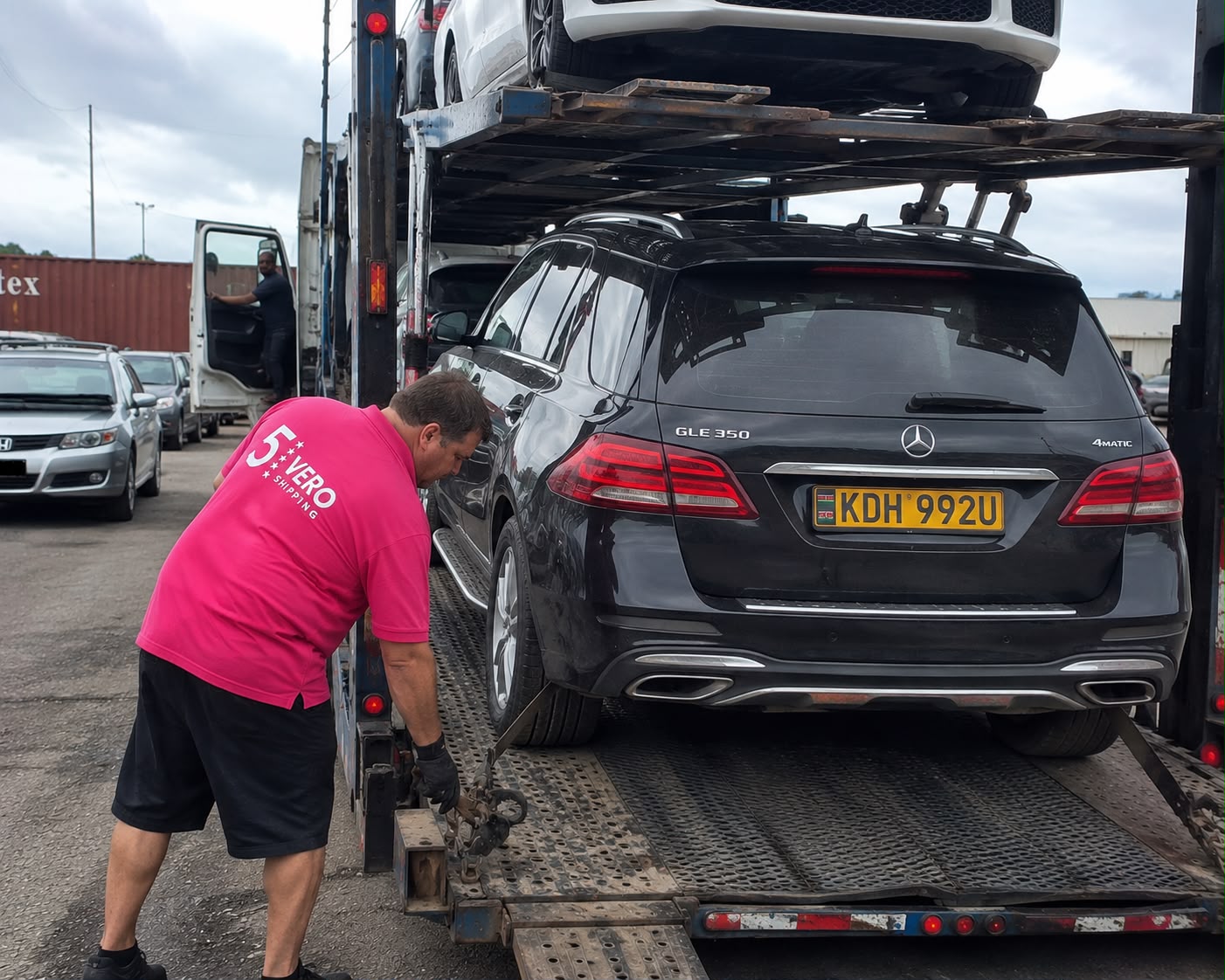
Electric Car Shipping from USA to Nigeria: Battery & Ocean Shipping Requirements
20 Aug 2026
Written by Abu Naif – International Shipping Expert | VERO Shipping
Meta Title: Electric Car Shipping from USA to Nigeria | Battery & Ocean Requirements
Meta Description: Shipping an electric car from USA to Nigeria? Learn EV battery rules, dangerous-goods classification, auction pickup, battery condition, container requirements, export documents and ocean shipping to Lagos and Apapa.
Electric Car Shipping from USA to Nigeria
Shipping an electric vehicle from the United States to Nigeria requires more planning than shipping a conventional gasoline-powered car. The lithium-ion battery changes the way the vehicle may be classified, booked, documented, accepted by the ocean carrier and handled inside the container.
For Nigerian buyers purchasing Tesla, Rivian, Ford Mustang Mach-E, Hyundai Ioniq, Kia EV, Mercedes EQ, BMW i-series or other electric vehicles from Copart, IAA, Manheim, dealerships or private sellers, battery condition must be considered before the vehicle is moved toward export.
Under the IMDG Code changes that became mandatory in 2026, lithium-ion battery-powered vehicles are classified as UN 3556 – Vehicle, Lithium Ion Battery Powered, Class 9. Maersk states that applicable battery-powered vehicle shipments must be declared using the correct UN classification and that non-compliance can result in delay or rejection. (Maersk)
VERO Shipping coordinates U.S. vehicle pickup, inland transportation, export preparation, container planning and international shipping, but EV acceptance must always be checked against the current carrier and battery condition before shipment.
USA Car Shipping to Lagos Nigeria | VERO Shipping
1. An Electric Vehicle Is Not Treated Like a Normal Gasoline Car
The first thing Nigerian buyers should understand is that the traction battery changes the shipping classification.
For conventional vehicles, dangerous-goods treatment depends on the vehicle and the applicable IMDG provisions. For lithium-battery electric vehicles, carriers can require a dedicated dangerous-goods declaration and battery-powered-vehicle classification.
Maersk's 2026 guidance states that lithium-ion battery-powered vehicles must now be declared under UN 3556, Class 9, while lithium-metal battery-powered vehicles use UN 3557 and sodium-ion vehicles use UN 3558. (Maersk)
This matters because an EV cannot simply be entered into a booking as an ordinary sedan without considering battery type and carrier requirements.
For Nigerian buyers, the correct sequence is:
Identify vehicle → Confirm battery type → Check battery condition → Confirm carrier acceptance → Prepare DG documentation → Plan container → Ship.
Container Car Shipping for Nigeria Dealers | VERO Shipping
2. Check Battery Condition Before Buying
The battery is one of the most important things to investigate before purchasing an EV at auction.
A vehicle may look repairable externally while the battery pack has impact damage, water exposure or thermal damage.
Before bidding, review:
Underbody damage
Side-impact damage
Flood history
Fire or heat exposure
Battery warnings
Vehicle power status
Charging status
Manufacturer alerts
The battery pack is often located beneath the passenger compartment, so underbody or side damage deserves special attention.
A damaged high-voltage battery is not only an expensive repair problem. It can also affect whether the carrier accepts the vehicle for international shipment.
Maersk's published vehicle-booking guidance states that where a lithium battery installed in a vehicle is damaged or defective, the battery must be removed under the cited IMDG provisions. (Maersk)
For Nigerian buyers, checking battery integrity before bidding can prevent purchasing a vehicle that becomes extremely difficult or impossible to move under the intended ocean-shipping plan.
Non-Running & Damaged Vehicle Shipping | VERO Shipping
3. Damaged EVs Need Special Review Before Pickup
A damaged electric vehicle should not automatically be treated like a damaged gasoline car.
The first logistics question is still whether the vehicle rolls and steers, but with an EV there is an additional question:
Is the high-voltage battery safe?
If the vehicle has severe impact damage near the battery pack, evidence of fire, thermal runaway, swelling, leaking coolant or major underbody intrusion, do not assume normal transportation is appropriate.
The vehicle may require specialized recovery or additional safety review.
For auction buyers, send VERO:
VIN
Auction lot/stock number
Exact location
Make/model
Damage type
Running/non-running status
Whether it rolls and steers
Battery-related warnings or visible damage
Do not simply describe the vehicle as “Tesla damaged.”
The more accurate the information, the easier it is to determine whether conventional inland transportation and later container shipping can even be considered.
USA Inland Car Transport for Nigeria Buyers | VERO Shipping
4. Flood-Damaged EVs Require Extra Caution
Flood-damaged electric vehicles deserve particularly careful evaluation.
Water exposure can affect the traction battery, high-voltage cabling, charging system, control modules and safety systems.
A flood-damaged EV may appear visually clean after drying, while hidden electrical or battery-related problems remain.
For Nigerian buyers, the combination of:
Flood Damage + Lithium Battery + International Ocean Shipping
should be treated as a higher-risk purchase than a normal cosmetic-damage vehicle.
Do not charge or attempt to revive a flood-damaged EV battery casually.
Before buying, review the auction history, photos, battery area and vehicle warnings.
If the vehicle has been submerged or there is uncertainty about the high-voltage battery, verify the shipping feasibility before placing the final bid.
A low auction price can be misleading if the carrier later refuses the vehicle because of battery condition.
Flood-Damaged Cars from USA Auctions for Nigerian Buyers | VERO Shipping
5. EVs Are Dangerous Goods for Ocean Shipping
This is one of the biggest differences between EVs and many conventional vehicles.
Maersk's current regulatory guidance states that lithium-ion battery-powered vehicles must be classified as UN 3556, Class 9 under IMDG Amendment 42-24. (Maersk)
Earlier Maersk guidance also required lithium-battery EVs to be booked as dangerous goods and required documents such as:
Dangerous Goods Declaration
Container Packing Certificate (Maersk)
The exact documentation and booking workflow can evolve, so customers should always verify the current requirements for the carrier and voyage at the time of shipment.
For Nigerian buyers, the practical lesson is simple:
Do not assume EV ocean freight can be booked using the same paperwork as a normal gasoline vehicle.
The battery chemistry and vehicle classification need to be declared accurately.
6. The 2026 UN Classification Changed
This is especially important because older online articles may still show UN3171 for battery-powered vehicles.
That information can now be outdated for lithium-ion vehicle shipments.
Maersk's January 2026 guidance states that, under mandatory IMDG Amendment 42-24, the generic UN3171 classification is no longer permitted for lithium- or sodium-ion powered vehicles. The updated classifications include:
UN 3556 — Vehicle, Lithium Ion Battery Powered
UN 3557 — Vehicle, Lithium Metal Battery Powered
UN 3558 — Vehicle, Sodium Ion Battery Powered (Maersk)
This is exactly why Nigerian buyers should avoid using an old shipping checklist copied from a previous year.
EV shipping is an area where carrier and IMDG requirements can change materially.
For VERO shipments, the current carrier requirements should be confirmed before the final booking is created.
7. Container Placarding May Be Required
Dangerous-goods container shipments can require external placarding.
Maersk's 2026 guidance recommends that hazardous containers subject to IMDG Special Provision 962 be placarded on all four sides to avoid gate-in disruption resulting from different port interpretations. (Maersk)
For Nigerian buyers, this is another reason EV shipping should be planned before the container arrives at the terminal.
The process is not simply:
Put Tesla in container → close doors → send to port.
The shipment may involve:
Correct UN classification
DG booking
DG documentation
Container packing requirements
Placarding
Carrier approval
Terminal acceptance
If these details are incomplete, the container can be delayed or rejected.
Vehicle Shipping to Apapa Port Nigeria | VERO Shipping
8. State of Charge Can Matter
Battery state of charge can be relevant to safety and carrier requirements, although the precise percentage requirement may vary by carrier, vehicle type and current regulations.
Customers should not assume one universal battery percentage applies to every EV shipment without checking the current carrier instructions.
The vehicle may also need sufficient battery power for safe positioning or handling, while overcharging before shipment may not be appropriate.
For damaged or non-running EVs, battery state-of-charge information can be difficult to obtain.
This is why the VIN and vehicle condition should be reviewed before the booking is finalized.
For Nigerian buyers, do not rely on a forum post saying:
“All EVs must be at exactly X% battery.”
Verify the current shipping-line instruction for the actual shipment.
9. Container Loading Needs More Planning
Electric vehicles can be heavier than comparable gasoline vehicles because of their traction batteries.
That affects container planning.
For example, the loading team should consider:
Vehicle weight
Length
Width
Height
Battery condition
Running/non-running status
Vehicle mobility
Number of other cars in the container
A Tesla Model 3, Rivian R1T and large Mercedes EQ SUV create very different loading situations.
The number of vehicles that can be loaded safely should therefore be based on the exact models.
For Nigerian dealers, EVs should not simply be mixed into a planned container without checking total weight, vehicle dimensions and dangerous-goods requirements.
Shipping SUVs & Pickup Trucks from USA to Nigeria | VERO Shipping
10. A Damaged Battery Can Stop the Shipment
This is the point Nigerian auction buyers need to understand before buying a cheap damaged EV.
The vehicle can be:
Purchased
Paid
Released
Transported to the warehouse
and still fail to proceed into the intended ocean shipment if the battery is determined to be damaged or unacceptable under the carrier's requirements.
Maersk's published IMDG guidance states that where a lithium battery installed in a vehicle is damaged or defective, the battery must be removed under the applicable provision. (Maersk)
Battery removal is not a simple routine warehouse service.
It requires appropriate technical and safety handling.
Therefore, severe battery damage can completely change the economics of an auction purchase.
For Nigerian buyers, this is why EV shipping feasibility should be checked before bidding on a heavily damaged vehicle.
11. U.S. Vehicle Export Requirements Still Apply
Dangerous-goods requirements do not replace standard U.S. vehicle export procedures.
A used EV exported from the United States is still a used self-propelled vehicle for CBP export purposes.
CBP currently requires the exporter to submit applicable export documents at least 72 hours before export, and EEI must be filed through AES 72 hours before export for used self-propelled vehicles going to a foreign country. (CBP Help Center)
If the vehicle has a U.S. title, CBP states that the original title or certified copy and required copies must be presented according to the export procedure. (CBP Help Center)
Therefore, EV export planning contains two separate compliance layers:
Vehicle Export Documentation
plus
Battery/Dangerous Goods Shipping Requirements
Both need to be ready.
USA to Nigeria Car Shipping Documents Checklist | VERO Shipping
12. Confirm Carrier Acceptance Before You Buy a Difficult EV
For a normal used EV in sound battery condition, international shipping may be straightforward when the correct DG requirements are followed.
For a heavily damaged EV, flood vehicle, burnt vehicle or one with suspected battery damage, the situation can be completely different.
Before buying, especially from Copart or IAA, send:
VIN
Vehicle Model
Auction Location
Damage Type
Battery Condition if Known
Running/Non-Running Status
Flood/Fire History
Underbody Damage Photos
VERO can then check the logistics and carrier side before the buyer commits to a vehicle based only on the auction price.
Copart confirms that Nigeria, including Lagos and Apapa, is among the international destinations supported through its shipping ecosystem, but specific vehicle acceptance remains subject to shipping requirements. (Copart)
Copart Car Shipping to Nigeria | VERO Shipping
Frequently Asked Questions About EV Shipping from USA to Nigeria
1. Can electric cars be shipped from USA to Nigeria?
Yes, electric vehicles can potentially be shipped from the United States to Nigeria, but they require more compliance planning than conventional vehicles.
Lithium-ion battery-powered vehicles are treated as Class 9 dangerous goods under current IMDG rules. Maersk's 2026 guidance identifies the correct classification as UN 3556 — Vehicle, Lithium Ion Battery Powered. (Maersk)
This means the shipment may require dangerous-goods booking, documentation, container packing requirements and appropriate placarding.
The vehicle must also satisfy standard U.S. vehicle-export requirements.
For Nigerian buyers, the most important first step is confirming that the vehicle's battery is in acceptable condition.
A normal undamaged EV and an accident-damaged EV with battery impact are not the same shipping job.
2. Are electric cars considered dangerous goods?
Lithium-ion battery-powered vehicles are treated as dangerous goods for ocean transportation under the current IMDG classification.
Maersk identifies lithium-ion battery-powered vehicles as UN3556, Class 9 under the 2026 rules. (Maersk)
This does not mean EVs cannot be shipped.
It means they need to be declared and handled under the applicable dangerous-goods procedures.
Customers should avoid assuming that because EVs are common road vehicles, they can be placed into any export container without additional documentation.
3. Is UN3171 still used for Tesla and other lithium EVs?
For current lithium-ion powered vehicle shipments under the IMDG Amendment 42-24 rules referenced by Maersk, UN3171 is no longer the correct generic classification.
Maersk states that lithium-ion battery-powered vehicles should be declared as UN3556. (Maersk)
This is important because older online guidance may still show UN3171.
Always use the current carrier and IMDG requirements when preparing the shipment.
4. Can I ship a damaged Tesla from Copart to Nigeria?
Potentially, but the battery condition needs to be reviewed carefully.
A Tesla with cosmetic body damage can be very different from one with severe underbody impact, fire damage or damage near the battery pack.
Before buying, check:
Battery area
Underbody
Flood/fire history
Running status
Warnings
Whether the vehicle rolls and steers
If there is evidence that the battery is damaged or defective, carrier acceptance can become significantly more complicated.
Do not buy a heavily damaged EV assuming it can automatically ship simply because a normal Tesla can.
5. Can a flood-damaged EV be shipped?
This requires special caution.
Water exposure can affect the high-voltage battery and associated systems even when the vehicle appears visually clean.
A flood-damaged EV should be assessed for battery safety before normal handling or ocean shipping is assumed.
Carrier acceptance should be checked before purchase when there is significant battery uncertainty.
For Nigerian buyers, flood-damaged EVs represent both repair risk and shipping risk.
6. Do EV batteries have to be removed before shipping?
A normal installed EV battery is not automatically removed simply because the vehicle is being exported.
However, Maersk's published guidance states that where an installed lithium battery is damaged or defective, it must be removed under the cited IMDG provision. (Maersk)
This is a major distinction.
Healthy installed battery: potentially shippable under the correct EV dangerous-goods requirements.
Damaged/defective battery: may require removal and a different handling solution.
7. What documents are required for ocean shipping an EV?
The exact package depends on the carrier and shipment, but dangerous-goods EV shipments can require documents such as a Dangerous Goods Declaration and Container Packing Certificate, as identified in Maersk's vehicle-booking guidance. (Maersk)
The booking must also use the correct current UN classification.
Separately, U.S. export documentation and AES/EEI requirements still apply to used vehicles. (CBP Help Center)
Therefore, there are both DG-shipping documents and standard vehicle-export documents.
8. Does the EV battery need a specific charge percentage?
Carrier requirements can vary, so Nigerian buyers should not assume there is one permanent universal percentage for every EV shipment.
The current requirement should be verified with the shipping line during booking.
This is particularly important because battery rules can evolve.
For a damaged or non-running EV, obtaining or adjusting state of charge may also not be straightforward.
The safest approach is to follow the current carrier instruction for the specific booking rather than using an old online recommendation.
9. Can EVs and gasoline cars be loaded in the same container?
This can depend on carrier approval, dangerous-goods rules, container planning and the exact vehicles.
Because an EV shipment can be classified as dangerous goods, the entire container needs to be prepared and documented accordingly.
Vehicle weight and dimensions also matter.
Do not assume an EV can simply replace one gasoline sedan in an existing container plan without rechecking the shipment.
For Nigerian dealers, provide the complete list of vehicles before the booking and loading plan are finalized.
10. Are hybrids treated the same as full electric cars?
Not necessarily.
Battery chemistry and propulsion type matter.
Older Maersk guidance classified lithium-battery hybrid vehicles separately from fully battery-electric vehicles. Current IMDG classifications should be checked based on the actual vehicle and battery system. (Maersk)
Do not describe the vehicle only as “hybrid.”
Provide the exact VIN, make and model so the applicable battery and propulsion type can be determined.
11. Does VERO ship EVs from Copart and IAA?
VERO can coordinate the logistics for EV purchases subject to the vehicle condition and current carrier acceptance.
The customer should provide:
VIN
Auction Lot/Stock Number
Exact U.S. Location
Vehicle Model
Battery Condition if Known
Running/Non-Running Status
Flood/Fire Damage Information
Underbody Damage
For a normal EV, the shipping plan can then be checked against the relevant dangerous-goods requirements.
For a heavily damaged EV, it is especially important to check before purchase rather than after it reaches the export facility.
12. What should I check before buying an electric vehicle for Nigeria?
Before bidding, check:
VIN
Title/Document Type
Battery Type
Battery Condition
Underbody Damage
Flood History
Fire/Heat Exposure
Vehicle Warnings
Running Status
Whether the Vehicle Rolls and Steers
Exact Auction Location
Carrier Acceptance
DG Requirements
U.S. Export Documentation
Container Compatibility
Do not calculate the purchase based only on:
Auction Price + Repair Cost.
For an EV, the real calculation is closer to:
Purchase + Inland Transport + Battery Risk + Dangerous-Goods Handling + Export + Ocean Shipping + Repair.
EV Shipping Checklist for Nigerian Buyers
Before shipping an electric vehicle, confirm:
✓ VIN and exact model
✓ Lithium-ion / lithium-metal / sodium-ion battery type
✓ Battery condition reviewed
✓ No unresolved fire or thermal damage
✓ Flood history checked
✓ Underbody damage reviewed
✓ Vehicle rolls and steers
✓ Current carrier acceptance confirmed
✓ Correct UN classification used
✓ Dangerous-goods documentation prepared
✓ Container placarding requirements checked
✓ U.S. title/export documentation ready
✓ AES/EEI and CBP 72-hour process handled
✓ Container weight/loading plan reviewed
✓ VIN linked to container and booking
For 2026 shipments, the key regulatory update is especially important:
Lithium-ion powered vehicle → UN 3556, Class 9 under the IMDG 42-24 rules referenced by Maersk. (Maersk)
The safest rule for Nigerian auction buyers is:
Do not buy a heavily damaged EV first and ask whether it can ship later. Check the battery and carrier requirements before bidding.


