

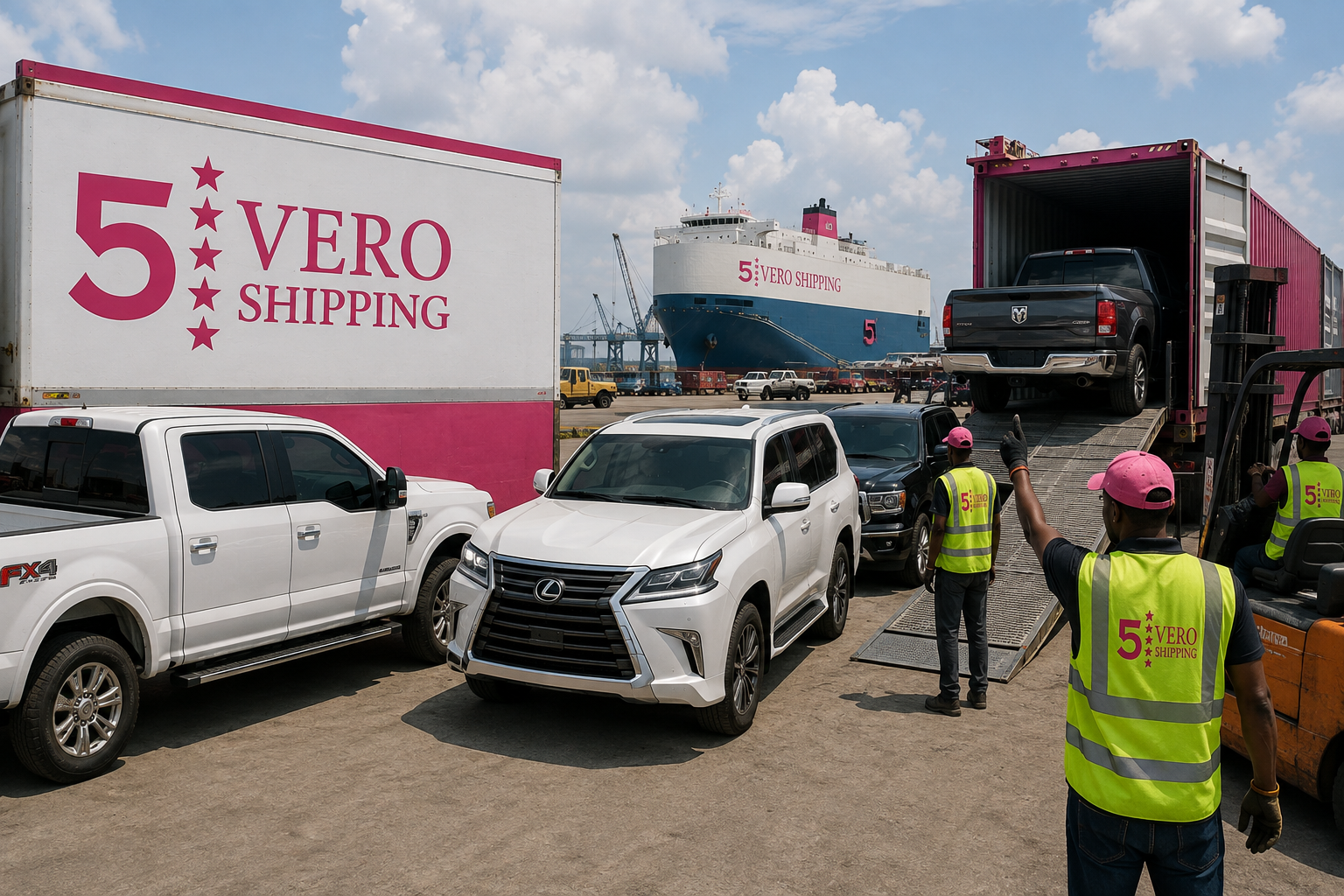
Shipping SUVs & Pickup Trucks from USA to Nigeria: Size, Loading & Transport Guide
18 Aug 2026
Written by Abu Naif – International Shipping Expert | VERO Shipping
Meta Title: Shipping SUVs & Pickup Trucks from USA to Nigeria | Size & Loading Guide
Meta Description: Shipping an SUV or pickup truck from USA to Nigeria? Learn how vehicle size, wheelbase, height, damage, inland transport and container loading can affect your shipping plan.
Shipping SUVs & Pickup Trucks from USA to Nigeria
SUVs and pickup trucks are popular purchases for Nigerian vehicle buyers sourcing cars from the United States, but larger vehicles require more shipping planning than a typical compact sedan.
A Toyota Highlander, Lexus GX, Ford Explorer, Toyota Tacoma, Ford F-150 or Chevrolet Silverado does not occupy the same amount of space as a smaller passenger car. Length, width, height, wheelbase and physical condition can influence U.S. inland transportation, warehouse handling and the way vehicles are arranged for container shipping.
This becomes especially important for dealers purchasing several vehicles for the same container. The question should not simply be “How many cars fit?” It should be “Which combination of vehicles can be loaded safely and efficiently?”
VERO Shipping's Nigeria dealer service specifically notes that sedans, SUVs, pickup trucks and damaged vehicles can require different container-loading arrangements. (Vero Shipping)
This guide explains what Nigerian buyers should check before buying and shipping larger vehicles from the USA.
USA Car Shipping to Nigeria | VERO Shipping
1. Vehicle Size Matters Before You Buy
Before purchasing an SUV or pickup truck for export to Nigeria, consider the physical dimensions of the vehicle—not only the auction price.
Length, width and height affect how much container space the vehicle occupies. A full-size pickup can require considerably more space than a compact sedan, while a large three-row SUV can also affect the loading configuration.
This matters especially when several vehicles are intended for the same shipment.
If a dealer purchases vehicles without considering their dimensions, the final group may not use the container as efficiently as expected.
VERO's Nigeria dealer shipping page specifically identifies vehicle size as a factor in container-space planning. (Vero Shipping)
For professional buyers, this means vehicle selection should include three calculations:
Purchase price + logistics cost + container compatibility.
A good auction deal can become less attractive if the vehicle creates an inefficient shipping combination.
Container Car Shipping for Nigeria Dealers
2. Compact SUVs and Full-Size SUVs Are Not the Same
The word SUV covers a very large range of vehicle sizes.
A compact crossover can be relatively close to a passenger sedan in overall dimensions, while a full-size SUV can be substantially longer, wider and taller.
Examples can include:
Compact / midsize SUVs: Toyota RAV4, Honda CR-V, Nissan Rogue.
Larger SUVs: Toyota Highlander, Ford Explorer, Lexus GX.
Full-size SUVs: Chevrolet Tahoe, GMC Yukon, Cadillac Escalade.
The logistics team should therefore receive the exact year, make and model before container planning.
Using only the description “SUV” does not provide enough information.
The same principle applies to damaged vehicles. A large SUV with suspension damage may require more handling than an undamaged vehicle of identical dimensions.
For Nigerian importers, knowing the exact vehicle dimensions before buying several cars can make later container planning much easier.
Vehicle Shipping to Apapa Port Nigeria
3. Pickup Truck Bed Length Can Change the Shipping Plan
Pickup trucks require special attention because the same model can be sold in several cab and bed configurations.
A Ford F-150, Chevrolet Silverado, GMC Sierra or RAM 1500 may have different overall lengths depending on whether it is a regular cab, extended cab or crew cab and whether it has a short or long bed.
This means two trucks carrying the same model name can occupy noticeably different container space.
Before buying, provide the exact VIN whenever possible. This helps identify the precise model configuration rather than planning around a generic vehicle name.
For Nigerian dealers purchasing multiple pickups, this becomes especially important.
Three pickups with different wheelbases may create a completely different loading configuration from three standard sedans.
Large trucks should therefore be evaluated individually before the container loading plan is confirmed.
USA Car Shipping to Lagos Nigeria
4. U.S. Inland Transportation Can Cost More for Larger Vehicles
The vehicle needs to reach the export facility before international shipping can begin.
Larger SUVs and pickup trucks can influence inland transportation because vehicle dimensions and weight affect transporter capacity.
A transporter carrying several compact sedans may be able to organize its load differently from a carrier collecting multiple full-size pickups.
Distance remains another major factor.
A large pickup purchased close to the export facility can have a different transportation requirement from the same truck located hundreds of miles away.
Nigerian buyers should therefore request inland transportation using the exact vehicle information and pickup location.
Do not assume that a rate quoted for a sedan automatically applies to a full-size SUV or pickup.
The exact logistics requirement should be reviewed before transportation is dispatched.
USA Inland Vehicle Transportation Guide
5. Damaged SUVs Can Require Additional Transport Planning
Many SUVs purchased from American auctions have collision damage.
Size alone does not determine how difficult they are to move. Wheel, steering and suspension condition can be equally important.
A large SUV that starts and rolls normally may be straightforward to collect. The same vehicle with a collapsed front suspension can require substantially more planning.
Before transportation is arranged, Nigerian buyers should check:
-
Does the SUV start?
-
Does it roll?
-
Does it steer?
-
Are all wheels present?
-
Is the suspension visibly damaged?
-
Are keys available?
These details should be communicated before the transporter reaches the auction yard.
A failed pickup can delay the vehicle's arrival at the export facility and interfere with the intended container schedule.
For salvage SUVs, always evaluate physical mobility + size together.
VERO Guide to Non-Running Vehicle Shipping
6. Damaged Pickup Trucks Need the Same Care
Pickup trucks can also have unique damage patterns.
Front-end collisions can affect suspension and steering, while rear or side damage can affect the bed or overall width of the truck.
Some pickups may have aftermarket equipment, oversized wheels, lift kits, toolboxes or other modifications that change their shipping dimensions.
These details matter.
A modified truck should not automatically be treated like a factory-standard version of the same model.
Before buying a pickup for Nigeria, review the auction photographs carefully and look for anything that changes the vehicle's overall physical profile.
If the truck is significantly modified, tell the logistics team before transportation and loading planning begins.
Copart currently offers a wide variety of trucks and SUVs through its online auction inventory, making exact vehicle identification particularly important when buyers are comparing different configurations. (Copart)
Browse Copart Cars, Trucks & SUVs
7. Container Capacity Depends on the Combination of Vehicles
One of the most common questions is:
How many SUVs or pickup trucks can fit in a container?
There is no responsible universal answer without knowing the exact vehicles.
Vehicle length, height, body shape, condition and loading arrangement all matter.
For example, a container containing:
Sedan + Sedan + midsize SUV + compact SUV
is different from:
Full-size pickup + full-size SUV + pickup truck.
This is why VERO reviews the planned inventory before loading rather than assuming the same vehicle count applies to every shipment. VERO's Nigeria dealer page specifically states that sedans, SUVs, pickup trucks and specialty vehicles require different loading arrangements. (Vero Shipping)
Nigerian dealers should therefore send the VINs and exact models before making purchasing decisions based on a presumed container capacity.
VERO Professional Container Vehicle Loading
8. Vehicle Height Can Be Just as Important as Length
Length is usually the first dimension buyers think about, but vehicle height also matters.
Large SUVs, pickup trucks and modified vehicles can sit considerably higher than standard passenger cars.
Lifted trucks deserve special attention because aftermarket suspension changes and oversized tires can increase overall height beyond the standard factory specification.
This can reduce loading flexibility.
For that reason, Nigerian buyers purchasing modified pickups should not provide only the basic make and model.
Mention modifications such as:
Lift kit
Oversized tires
Roof accessories
Truck racks
Raised suspension
When possible, provide photographs and exact dimensions.
A stock pickup and a heavily modified version may require different loading arrangements even though they share the same VIN family and model name.
Container preparation should always reflect the vehicle in its current physical condition.
Copart Car Shipping to Nigeria
9. Weight Also Affects Transport Planning
Larger vehicles are generally heavier than compact passenger cars, and weight becomes another factor during both inland and container transportation planning.
Heavy SUVs and pickups affect how carriers arrange vehicles on U.S. transport equipment.
When several large vehicles are shipped together, the total shipment configuration should therefore be evaluated rather than treating every vehicle as an identical unit.
This does not mean larger vehicles cannot be shipped.
It simply means the logistics plan needs more accurate information.
IAA's marketplace currently includes dedicated pickup-truck inventory, illustrating the wide range of truck sizes and conditions available to auction buyers. (iaai.com)
Nigerian buyers purchasing trucks should provide the exact model rather than requesting transportation using a generic description such as “pickup.”
Browse IAA Pickup Truck Inventory
10. Loading Running and Non-Running SUVs Is Different
A running SUV that can move under its own power offers more handling flexibility than a non-running SUV with locked wheels.
That difference becomes important during final container preparation.
When a vehicle does not move normally, additional equipment may be required to position it correctly.
The same applies to pickup trucks.
A damaged full-size pickup with steering problems can require more handling than a compact non-running sedan.
For Nigerian dealers, the container group should therefore be evaluated using:
Dimensions + weight + physical mobility + documentation readiness.
Do not group cars only because they arrived at the warehouse during the same week.
The best loading group is usually the one that works operationally and physically.
VERO coordinates damaged and non-running vehicle preparation as part of the wider export workflow.
VERO Nigeria Vehicle Shipping Services
11. Dealers Should Plan Vehicle Mix Before Bidding
Professional Nigerian dealers can improve shipping efficiency by considering container compatibility before purchasing.
Imagine you plan to buy four vehicles.
If all four are large pickups, your loading options can be very different from a mixed group containing smaller vehicles.
Instead of asking only:
Which vehicle has the lowest auction price?
also ask:
How will this vehicle fit into my planned shipment?
This can influence profitability across a larger inventory.
A truck that appears slightly more expensive at auction but works better with the existing vehicle group may sometimes make more logistical sense.
Dealers should therefore keep a running list of vehicles already purchased and compare new auction candidates against that group.
This turns container planning into part of the buying strategy rather than something discovered after all vehicles have already been purchased.
Container Shipping for Nigerian Vehicle Dealers
12. Send Exact Vehicle Details Before Requesting a Quote
The best quotation starts with accurate information.
For an SUV or pickup truck, send:
VIN
Year
Make
Model
Exact U.S. location
Running/non-running status
Known damage
Keys available or missing
Vehicle modifications
Number of vehicles planned for shipment
If you purchased through an auction, also provide the lot or stock number.
Avoid asking for a quote using only:
“How much for SUV to Nigeria?”
There are too many possible vehicle sizes and locations for that question to produce an accurate logistics plan.
The more specific the vehicle information, the easier it is to evaluate U.S. inland transportation and the international loading arrangement.
This is especially important for large pickups and modified SUVs.
USA Vehicle Shipping to Apapa Port
Frequently Asked Questions About Shipping SUVs & Pickup Trucks from USA to Nigeria
1. Can I ship an SUV from the USA to Nigeria?
Yes. SUVs can be shipped from the United States toward Nigeria as part of a container vehicle-shipping plan.
The important consideration is that SUVs vary significantly in size.
A compact crossover and a full-size SUV should not automatically be treated as identical cargo.
Before planning the shipment, provide the exact year, make, model and VIN. Vehicle condition should also be disclosed, particularly if the SUV is damaged or non-running.
The U.S. pickup location affects inland transportation, while the vehicle's dimensions and mobility affect container planning.
For dealers shipping several vehicles, the SUV also needs to be evaluated alongside the other cars intended for the same shipment.
A combination containing several full-size SUVs can require a different arrangement from a mixed shipment containing compact sedans.
The most useful approach is therefore to plan according to the actual vehicles rather than relying on generic vehicle categories.
2. Can pickup trucks be shipped from USA to Nigeria?
Yes. Pickup trucks can be included in international vehicle shipments toward Nigeria, but the exact truck configuration matters.
A midsize pickup such as a Toyota Tacoma can have very different dimensions from a full-size crew-cab Ford F-150, Chevrolet Silverado or RAM 1500.
Bed length and cab configuration can also change overall vehicle length.
For this reason, the logistics team should receive the exact VIN or model configuration before planning transportation and loading.
If the truck has been modified with a lift kit, oversized tires or other accessories, disclose those modifications.
Physical condition matters as well.
A running pickup is different from a damaged truck with steering or suspension problems.
For Nigerian dealers, pickups should always be included in the container calculation before purchasing a full group of vehicles.
3. Do SUVs cost more to transport inside the USA than sedans?
They can, depending on the specific vehicle and route.
U.S. inland transportation pricing is influenced by distance, vehicle dimensions, weight, condition and carrier availability.
A compact SUV may be relatively straightforward, while a large full-size SUV occupies more transporter capacity.
A damaged SUV can create additional considerations if it does not roll or steer normally.
The exact pickup location is also critical.
A vehicle located near the export operation can have a different inland cost from an identical SUV located several states away.
Nigerian buyers should therefore request transportation using the exact VIN or make/model plus pickup location.
Do not assume that a previous sedan transportation rate will automatically apply to a larger SUV.
For dealers buying regularly, checking inland transportation before bidding can improve the accuracy of the total vehicle-cost calculation.
4. Does a pickup truck cost more to ship than a small car?
It can, particularly because a pickup may occupy more space during both inland transportation and container loading.
However, there is no universal fixed difference.
The exact truck matters.
A midsize pickup and a long-wheelbase full-size crew-cab truck are not the same shipment.
Location, vehicle condition and current shipping arrangements can also affect the final logistics cost.
For this reason, a quotation should be prepared using the actual truck information.
Professional buyers should avoid using a standard sedan rate as a planning figure for every pickup.
For Nigerian dealers, the better calculation is:
Truck purchase price + inland transportation + export preparation + container-space impact + ocean shipment.
Looking at the entire logistics picture is more useful than comparing only the auction purchase price or one freight component.
5. How many SUVs can fit inside one container?
There is no single number that should be guaranteed without reviewing the actual vehicles.
SUVs differ greatly in length, height and width.
For example, compact SUVs and full-size SUVs create completely different loading situations.
Physical condition can also influence the loading arrangement. A vehicle with locked wheels or damaged suspension may require more handling than a normal running SUV.
The best approach is to provide the VINs and models of all vehicles planned for the container.
The loading team can then evaluate the group based on the actual cars.
This is particularly important for Nigerian dealers purchasing several vehicles specifically with one container in mind.
Do not complete all purchases based solely on a fixed assumption about the number of SUVs that will fit.
Plan the vehicle combination before the final buying decisions whenever possible.
6. How many pickup trucks can fit in a 40-foot container?
The answer depends on the exact pickup trucks.
Truck length varies significantly according to the cab and bed configuration, and full-size pickups can occupy substantial container space.
A long-bed crew-cab truck should not be treated like a smaller midsize pickup.
Modifications can further change the dimensions.
For example, oversized tires or suspension lifts can increase vehicle height.
Vehicle condition can also affect positioning during loading.
For this reason, VERO does not recommend using one guaranteed truck count for every 40-foot container.
Nigerian dealers should provide exact model information and VINs before confirming a loading plan.
If you are still purchasing vehicles, tell the logistics team which trucks you are considering.
This gives you a better chance to build an efficient vehicle combination before the entire inventory has already been purchased.
7. Can a damaged SUV be shipped to Nigeria?
Potentially yes, provided the vehicle can be transported and has documentation appropriate for the intended U.S. export process.
The first issue is physical condition.
Determine whether the SUV starts, rolls and steers. Check the wheels and suspension for visible collision damage.
A damaged SUV with all wheels functioning can have different handling requirements from one with collapsed suspension.
The second issue is documentation.
Physical transportability does not automatically mean the vehicle is export-ready.
Both the vehicle and applicable ownership/export documents should progress through the required preparation stages.
For Nigerian salvage buyers, it is therefore useful to think of the SUV as two separate checks:
Can we move it?
and
Can we export it?
Resolving both questions early makes the wider shipping process easier to plan.
8. Can a damaged pickup truck be loaded into a container?
It may be possible, but the loading plan depends on how badly the pickup is damaged.
A truck with cosmetic body damage but normal wheels and steering is very different from a pickup with collapsed suspension or major frame-related damage.
The loading team needs to understand whether the vehicle can roll and steer and whether special equipment is necessary to position it.
Truck dimensions can already reduce available loading flexibility compared with a smaller sedan, so severe damage can add another factor.
Nigerian buyers should therefore send photographs or auction information when the truck has significant damage.
Do not wait until the day of loading for the warehouse team to discover that the pickup cannot move normally.
Early information allows inland transportation, warehouse handling and container loading to be planned around the same physical condition.
9. Should I check vehicle dimensions before buying at Copart or IAA?
Yes, especially when purchasing SUVs and pickup trucks for a multi-vehicle container.
Auction buyers often focus on vehicle value, damage and repair cost, but shipping dimensions can also influence the economics of the purchase.
If you already have three vehicles planned for a shipment, a fourth large truck may create a very different container configuration from a compact sedan.
Before bidding, check the exact model and configuration.
For pickups, pay attention to cab type and bed length.
For SUVs, identify whether the vehicle is compact, midsize or full-size.
If the vehicle is modified, consider whether those modifications change overall height or width.
This is particularly useful for Nigerian dealers who want to optimize container use across repeated shipments.
10. Do oversized wheels or a lift kit affect shipping?
They can.
Aftermarket modifications can change the vehicle's overall dimensions and handling characteristics.
A lifted pickup can sit higher than the standard factory model, while oversized tires can increase height and sometimes width.
Truck racks, roof accessories and other equipment can also influence the vehicle's physical profile.
These details should be communicated before container planning.
Do not provide only the factory make/model if the actual vehicle has significant modifications.
For inland transportation, modifications may also affect how the transporter accommodates the vehicle.
Nigerian buyers purchasing modified trucks at auction should review photographs carefully and mention visible modifications when requesting a shipping quotation.
The shipping plan should always reflect the vehicle as it currently exists, not only its original factory specification.
11. Is it better for Nigerian dealers to mix sedans and SUVs in one shipment?
Sometimes a mixed group can provide more loading flexibility, but there is no universal combination that is always best.
The correct mix depends on the exact dimensions and condition of each vehicle.
For example, smaller sedans can create a different container arrangement around a larger SUV or pickup than a shipment composed entirely of large vehicles.
Professional dealers should therefore think in terms of vehicle compatibility, not only vehicle count.
Keep a list of purchased inventory and provide the VINs when planning the next shipment.
If you are still buying, consider whether the next vehicle complements or complicates the existing group.
Over time, this can make container planning part of the dealer's purchasing strategy.
The objective is not necessarily to maximize the number of vehicles at any cost. It is to create a practical and properly planned shipment.
12. What information should I send for an SUV or pickup shipping quote?
For the most useful logistics estimate, provide:
VIN
Year
Make
Model
Exact U.S. pickup location
Auction or seller
Running/non-running condition
Known damage
Keys available or missing
Any modifications
Number and type of other vehicles intended for the shipment
If it is a pickup truck, identifying the cab and bed configuration can also be useful.
If it is modified or heavily damaged, provide additional information or photographs when available.
The final international shipping plan depends on more than the destination country.
For large vehicles, exact dimensions and condition matter considerably.
The earlier VERO receives this information, the easier it is to evaluate inland transportation and container planning before the vehicle reaches the final loading stage.
SUV & Pickup Truck Shipping Checklist for Nigeria Buyers
Before buying or shipping, check:
✓ Exact year, make and model
✓ VIN
✓ Compact, midsize or full-size SUV
✓ Pickup cab and bed configuration
✓ Exact U.S. pickup location
✓ Running or non-running condition
✓ Vehicle rolls and steers
✓ Wheel and suspension damage
✓ Lift kits or oversized tires
✓ Overall vehicle combination for the container
✓ Export documentation status
✓ Container loading plan before final shipment
For dealers, the key rule is:
Do not ask only “How many vehicles fit?”
Ask:
“How do THESE exact vehicles fit together?”
That is the better way to plan SUVs and pickup trucks for shipment from the USA to Nigeria.


