

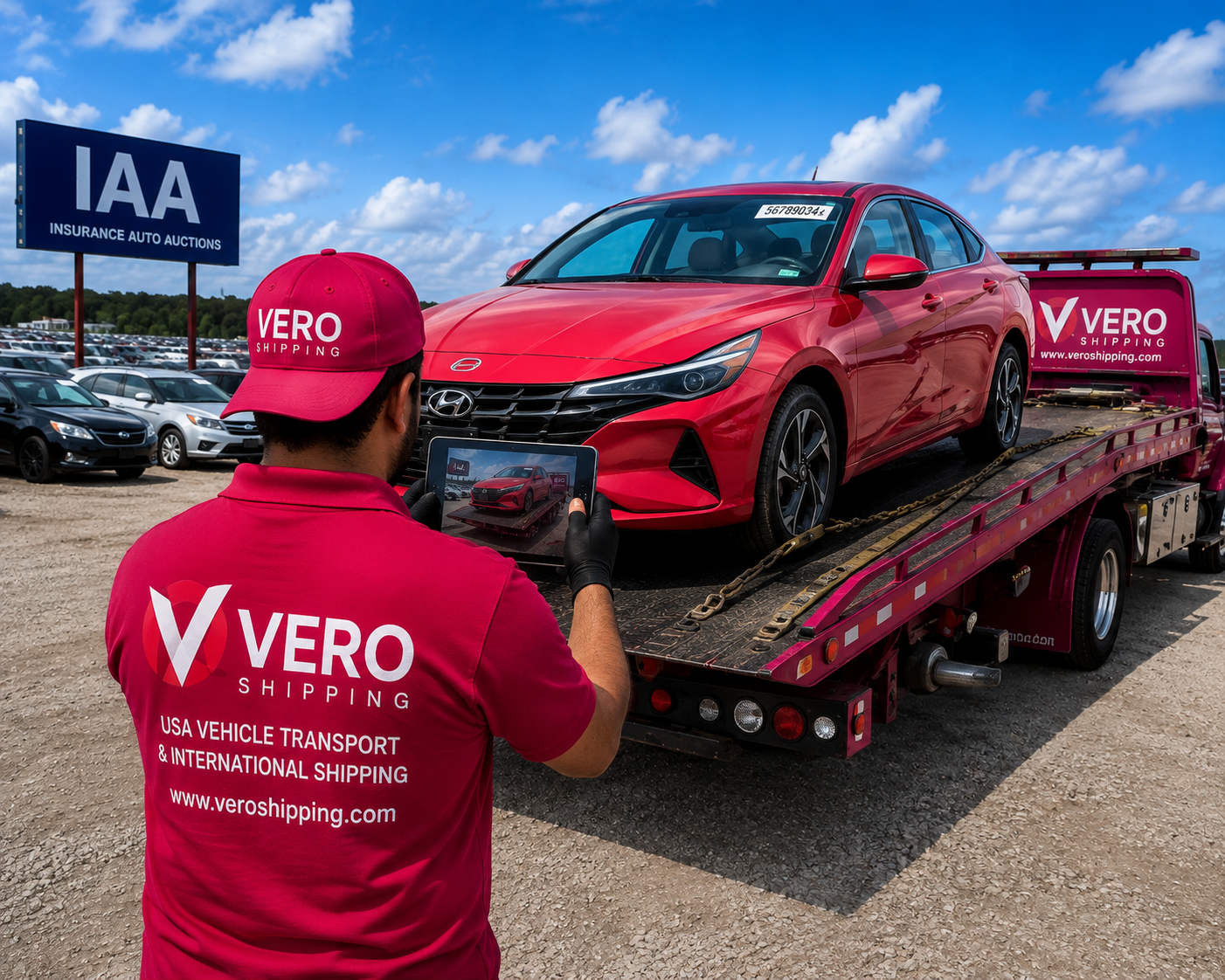
USA Inland Vehicle Transportation: 10 Problems After Buying from Copart & IAA
13 Aug 2026
Buying a vehicle from Copart or IAA is only the first step.
For many international buyers, the real operational work begins after the vehicle is purchased. The vehicle still needs to be released by the auction, collected by the correct carrier, inspected at pickup, transported across the United States, delivered to the correct export facility, and prepared for international shipping.
At VERO Shipping, USA inland vehicle transportation is not treated as simply sending a truck to collect a car.
Our dispatch team deals with real operational problems every day: unpaid vehicles, auction storage fees, last-minute location changes, off-site pickups, missing keys, title mistakes, remote locations, difficult sellers, and vehicles whose condition at pickup differs from the original auction photographs.
Understanding these problems before they happen can save importers significant time and unnecessary transportation expenses.
For buyers who are new to American auctions, see our Complete Guide to Importing Cars from Copart and IAA before purchasing.
1. The Customer Requests Transportation Before the Vehicle Is Paid
This is one of the first problems our dispatch team encounters.
A customer wins a vehicle and immediately asks:
“Can you send the driver?”
But winning the auction does not necessarily mean that the vehicle is ready for pickup.
Sometimes the customer purchased the vehicle through his own account or another auction account rather than an account managed through VERO Shipping.
The customer may believe payment has been completed while the auction system still shows an outstanding balance, pending transaction, release restriction, or another issue.
If a carrier is dispatched before this is verified, the driver may arrive and discover that the auction will not release the vehicle.
That can create:
-
Driver waiting charges
-
Dry-run charges
-
Additional mileage
-
Rescheduling
-
Storage charges
-
Lost transportation time
When the vehicle is purchased through an account managed by VERO Shipping, our team has greater visibility into the transaction and can verify important information before dispatch.
Our rule is simple: check first, dispatch second.
Customers who need a broader explanation of the process can also read How to Buy Cars from Copart & IAA and Ship Them to the UAE.
2. Auction Storage Fees Have Already Started
Another common surprise is storage.
Copart and IAA provide pickup deadlines according to their applicable terms and the specific sale. When a vehicle remains beyond the applicable free or allowed period, charges may begin accumulating.
The buyer sometimes does not notice this.
He calls the shipping company and asks for immediate pickup.
The driver accepts the order, travels to the auction and then discovers that money is owed before the vehicle can be released.
Now everybody has a problem.
The driver is waiting.
The dispatch department is calling the customer.
The customer is trying to determine why additional money is required.
Meanwhile, the transportation schedule is being disrupted.
This is why checking the vehicle status before dispatch is extremely important.
3. The Vehicle Location Changes at the Last Minute
Inland transportation pricing depends heavily on distance.
Imagine that our dispatch department receives a pickup address and calculates transportation based on that location.
A driver accepts the vehicle.
Then we discover that the actual vehicle location has changed.
A relatively small location change may be manageable.
A major change can completely alter the transportation cost.
The carrier may need to drive additional empty miles, change his route, or reject the load entirely.
This is particularly important when the vehicle is located far from a major transportation corridor.
VERO Shipping's dispatch team therefore verifies pickup information and communicates location changes as quickly as possible.
4. The Vehicle Is an Off-Site Sale
This deserves special attention.
A vehicle sold through Copart or IAA is not always physically sitting inside a traditional auction yard.
Some vehicles are off-site.
For example, a dealership may sell a vehicle through an auction platform while keeping the car at its own facility.
After the sale, the shipping company receives the actual pickup location.
Now the process is different.
The driver isn't dealing with the normal auction-yard procedure. He may be dealing directly with a dealer, storage facility, repair shop, private facility, or another third-party location.
Some sellers are excellent.
They answer the telephone, prepare the vehicle, locate the key and documents, and help the driver load.
Others can be difficult.
The driver may arrive and discover:
-
Nobody knows about the vehicle
-
The car is blocked by other vehicles
-
The key is missing
-
The vehicle cannot roll
-
Pickup hours have changed
-
Loading assistance is unavailable
-
The seller is difficult to contact
This is why an off-site pickup requires active dispatch coordination.
5. The Vehicle Has No Key
A missing key sounds like a small problem.
Operationally, it can become a large one.
A running vehicle with a key can often be loaded relatively easily.
A damaged vehicle without a key may require different equipment and additional work.
Sometimes auction photographs or information indicate a key, but the driver cannot locate it when he arrives.
When this happens, our driver documents the situation and informs the VERO dispatch employee.
This gives us a record of what was found at the pickup location instead of discovering the problem days later at the loading warehouse.
6. The Driver Receives the Wrong Title
Drivers can make mistakes.
Auction employees and sellers can make mistakes too.
One situation we have encountered is a driver leaving a pickup location with a title or document belonging to another vehicle.
This is not a small issue for an international vehicle exporter.
The car may already be hundreds of miles away when the documentation department discovers that the VIN on the title does not correspond to the VIN of the vehicle.
VERO Shipping then has to coordinate between the driver, auction or seller, dispatch department, documentation team and export facility to locate the correct document.
A mistake that takes seconds at pickup can require days of work to correct.
This is why title control becomes an important part of international vehicle logistics.
7. The Vehicle Has a Title That Creates an Export Problem
Another important lesson for international buyers:
A vehicle having paperwork does not automatically mean it can be exported without problems.
Different title brands and document types exist in the United States.
Depending on the documentation and circumstances, additional requirements or restrictions may apply before a vehicle can be exported.
International buyers should therefore review the available title information before bidding whenever possible.
VERO Shipping already maintains dedicated educational content about vehicle titles and export documentation, because documentation problems can delay the entire shipment.
A buyer may save $500 purchasing a cheaper vehicle and later lose considerably more money because of a documentation problem.
For new importers, our Copart and IAA Import Guide explains why document review should begin before transportation.
8. Choosing the Wrong Driver Can Create Bigger Problems Than Choosing a Higher Price
The cheapest carrier is not automatically the best carrier.
Our dispatch employees consider more than price.
They need to consider:
-
Driver experience
-
Equipment
-
Vehicle condition
-
Pickup location
-
Distance
-
Timing
-
Communication
-
Reliability
-
Ability to handle non-running vehicles
A normal running sedan is different from a severely damaged SUV.
A vehicle sitting inside a major Copart location is different from a non-running vehicle sitting at a remote off-site dealer.
Selecting the right driver is part of the transportation service.
9. Remote Pickups Can Change the Transportation Cost
The United States is enormous.
Not every auction vehicle is located near Houston, Savannah, New Jersey, Los Angeles, Chicago, or another major transportation market.
Some vehicles are located in remote areas.
There may be very few carriers operating near that ZIP code.
A driver might have to travel a significant distance without cargo just to reach the vehicle.
This is called deadhead mileage, and it affects transportation economics.
This is why two vehicles purchased for similar prices can have very different inland transportation costs.
The pickup ZIP code matters.
The vehicle condition matters.
Carrier availability matters.
Distance to the VERO loading facility matters.
10. The Vehicle Looks Different When the Driver Arrives
This is one of the most important controls in the VERO Shipping inland transportation process.
When our assigned carrier reaches the vehicle, the driver takes pickup photographs whenever possible and sends them to the VERO Shipping dispatch employee.
The dispatch employee compares those photographs with the available purchase or auction photographs.
We look for visible differences such as:
-
Additional body damage
-
Broken glass
-
Missing parts
-
Different wheels
-
Missing bumper components
-
Changed vehicle condition
-
Other obvious discrepancies
If we identify an important difference, we document it and communicate the issue before the vehicle continues through the logistics chain whenever possible.
This is important because the vehicle will pass through several hands:
Seller/Auction → Inland Carrier → VERO Yard → Container Loading → Port → Ocean Carrier → Destination
Photos create a condition record at an important point in that chain.
USA inland transportation therefore isn't simply:
“Send a truck and pick up the car.”
It is a coordinated logistics operation.
How VERO Shipping Manages USA Inland Vehicle Transportation
Our objective is to identify problems before they become expensive problems.
Depending on the shipment, our process can include checking the pickup information, confirming vehicle status, assigning an appropriate carrier, monitoring transportation, collecting pickup photographs, identifying visible discrepancies, coordinating title issues and delivering vehicles to the appropriate export/loading facility.
From there, the vehicle can move into export preparation and professional container loading.
Customers interested in the complete process can read the VERO Copart & IAA USA-to-UAE Shipping Guide.
VERO also provides international vehicle shipping services after the inland transportation stage, including export preparation, container loading and ocean transportation.
33 Frequently Asked Questions About USA Inland Vehicle Transportation
1. What is USA inland vehicle transportation?
It is the transportation of a vehicle inside the United States from an auction, dealer, seller or other pickup location to a warehouse, loading facility, port or export facility.
2. Can VERO Shipping pick up vehicles from Copart?
Yes. VERO Shipping coordinates inland transportation for vehicles purchased from major U.S. auctions, including Copart.
3. Can VERO Shipping collect vehicles from IAA?
Yes. IAA auction vehicles can be transported to the appropriate VERO export or loading facility.
4. Can you transport a vehicle immediately after I win the auction?
Not necessarily. Payment, release status and pickup requirements should be checked first.
5. What happens if my vehicle has not been paid for?
The auction may refuse to release it. Dispatching a driver before resolving payment can therefore create additional costs.
For an overview of the complete purchasing process, read our Copart & IAA Import Guide.
6. Why should the vehicle status be checked before sending a driver?
Because a carrier can travel a long distance only to discover that the vehicle cannot be released.
7. What happens when the auction's pickup period expires?
Storage or other applicable charges may become due according to the auction's terms.
8. Does VERO check for outstanding issues before pickup?
Our dispatch team checks available vehicle and pickup information before dispatch whenever possible.
9. What is an off-site Copart or IAA vehicle?
It is a vehicle sold through the auction platform but physically stored at another location.
10. Can VERO collect an off-site vehicle?
Yes, provided the pickup location and release arrangements allow collection.
11. Why can off-site transportation be more difficult?
Because the driver may need to coordinate directly with a dealer or third-party location rather than a standard auction yard.
12. What happens if the pickup address changes?
The transportation route and price may need to be recalculated depending on the new distance.
13. Can changing the pickup ZIP code increase the transportation price?
Yes. Distance and carrier availability are major factors in inland transportation pricing.
14. What happens if the vehicle has no key?
The carrier may require additional equipment or loading assistance, particularly if the vehicle is non-running.
15. Can VERO transport non-running vehicles?
In many cases, yes, but the vehicle condition must be known so appropriate transportation equipment can be arranged.
16. Why does VERO ask about the vehicle's condition?
Because running, non-running and heavily damaged vehicles can require different trucks and loading procedures.
17. Does the driver photograph the vehicle?
VERO's pickup procedure calls for drivers to provide vehicle photographs when possible so our dispatch team can document the condition at collection.
18. Why are pickup photographs important?
They help establish the visible condition of the vehicle when the inland carrier receives it.
19. Does VERO compare pickup photos with auction photos?
Our dispatch team can compare the driver's photographs against available auction/purchase photographs to identify significant visible differences.
20. What happens if new damage is noticed?
The difference should be documented and communicated so there is a record before the vehicle moves further through the shipping process.
21. Can a driver accidentally receive the wrong title?
Mistakes can happen. If discovered, our team works with the relevant parties to correct the documentation.
22. Why must the VIN on the title be checked?
Because the ownership/export documents must correspond to the correct vehicle.
23. Can every U.S. vehicle title be used for export?
No. Documentation and title status should be reviewed because different title types and circumstances can affect export eligibility or requirements.
24. Should I check the title before buying?
Yes. International buyers should examine title information before bidding whenever possible.
Our Complete Copart & IAA Import Guide provides additional guidance for buyers.
25. Can VERO help with export preparation after inland transportation?
Yes. Inland transportation is one part of VERO's broader vehicle export and international shipping operation.
26. How is inland transportation price calculated?
Important factors include pickup location, delivery location, mileage, vehicle size, condition, carrier availability and required equipment.
27. Why are remote vehicles more expensive to transport?
Fewer carriers may operate in remote locations, and the driver may have to travel additional empty miles to collect the vehicle.
28. Is the cheapest carrier always the best choice?
No. Reliability, equipment, communication, timing and experience are also important.
29. Can VERO collect vehicles from dealers?
Yes. VERO coordinates pickups from dealers and other vehicle sellers in addition to auction facilities.
30. What happens after my vehicle reaches the VERO facility?
Depending on the shipment, the next steps can include inspection, documentation, export preparation and container loading before international transportation.
For an example of the full USA-to-destination process, see How to Buy Cars from Copart & IAA and Ship Them to UAE.
31. Can several vehicles be collected from different states?
Yes. Vehicles can be collected individually from different locations and consolidated according to the customer's shipping plan and available logistics arrangements.
32. Why should I use one company for inland transportation and international shipping?
Keeping transportation, documentation, loading and export coordination within one logistics chain can reduce communication gaps between different stages of the shipment.
33. What information should I send VERO to request an inland transportation quote?
Send the vehicle VIN or auction lot information, exact pickup location when available, vehicle condition, key status, and intended delivery/export destination.
This allows our dispatch team to evaluate the transportation requirement before assigning a carrier.
Final Advice for Copart & IAA Buyers
Do not wait until after purchasing a vehicle to think about transportation.
Before bidding, consider:
Title → Vehicle Condition → Auction Location → Inland Transportation → Export → Container Loading → Ocean Shipping
A vehicle with a low auction price can become expensive when it is located far from an export facility, has documentation problems, is missing a key, cannot roll, or accumulates storage charges.
Professional USA inland transportation is therefore not simply about moving a vehicle from Point A to Point B.
It is about controlling the vehicle from the moment it is released until it reaches the export facility.
VERO Shipping provides USA inland vehicle transportation, Copart & IAA pickup coordination, vehicle export preparation, container loading and international vehicle shipping.


