

China Warehouse Services for International Buyers | Receiving, Storage, Inspection & Consolidation
20 Oct 2026
Buying products from China is only the first part of the international supply chain.
After placing orders with factories and suppliers, international buyers still need to answer several important questions:
Where should suppliers deliver the goods?
Who will confirm that the cartons arrived?
How can a buyer outside China see the condition of the shipment?
What happens if different suppliers deliver on different days?
Where can the cargo wait before international shipping?
And who prepares everything for export once the buyer is ready to ship?
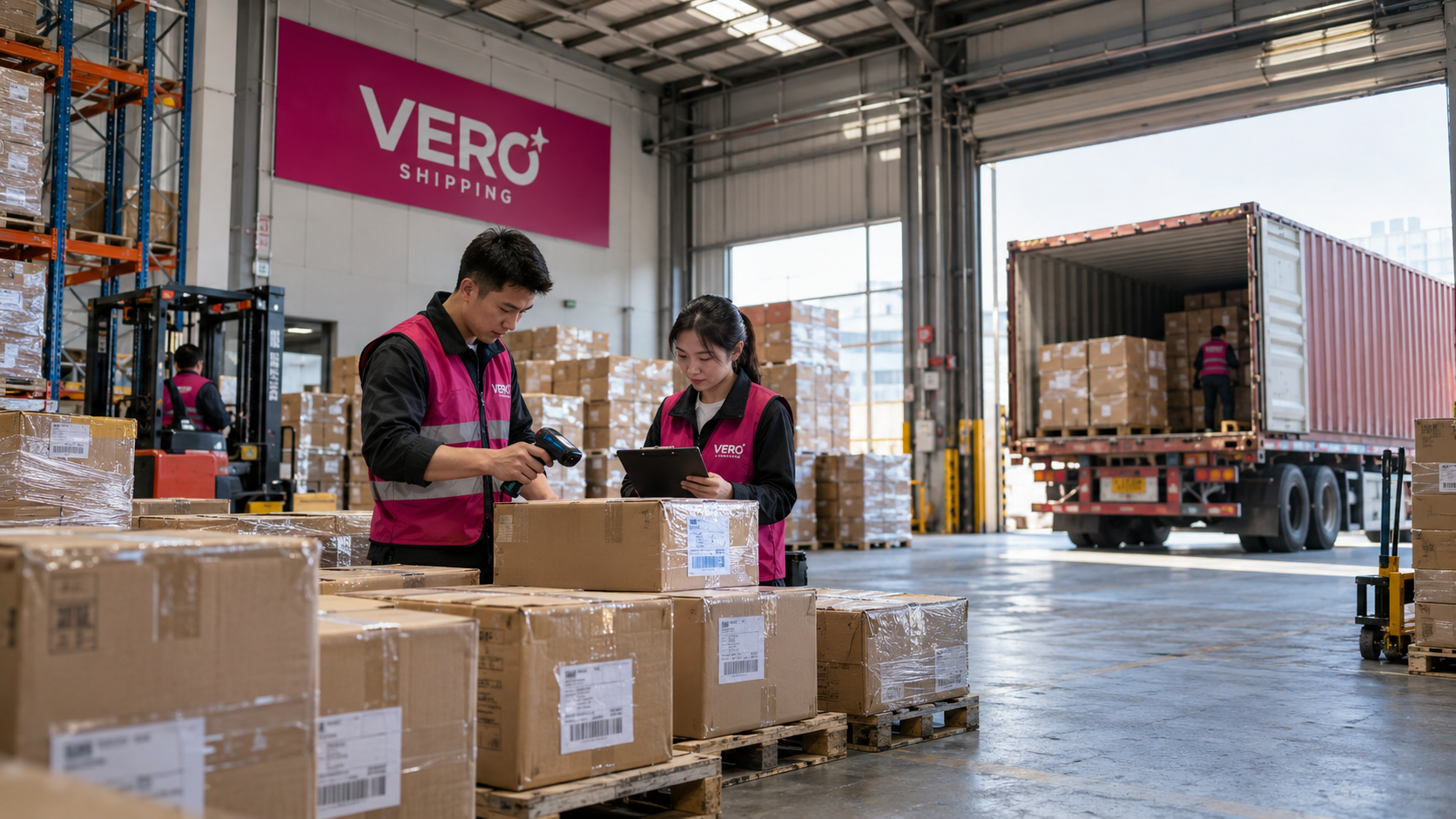
A China warehouse service for international buyers provides a central location where goods can be received, recorded, temporarily stored, checked for visible external condition, photographed, organized, repacked when required, labeled, consolidated, and prepared for international transportation.
This can be particularly useful for wholesalers, retailers, e-commerce businesses, spare-parts traders, project suppliers, distributors, and companies purchasing from factories across China.
VERO Shipping's China logistics model is designed to connect local warehouse operations in China with international shipping services, allowing customers to manage cargo through one coordinated logistics process.
Why Do International Buyers Need a Warehouse in China?
Many international buyers purchase directly from Chinese factories but do not maintain their own physical operation in China.
This creates a practical problem.
A factory can manufacture the products, but the buyer still needs somewhere to receive them before international transportation.
When purchasing from only one supplier, the factory may sometimes coordinate directly with a freight provider.
However, the process becomes more complicated when the buyer purchases from multiple factories, needs temporary storage, wants receiving photos, or is not ready to ship immediately.
A warehouse creates a physical logistics point between the supplier and the international transportation stage.
The process can look like this:
Supplier → China Warehouse → Receiving & Storage → Cargo Preparation → International Shipping → Destination
Instead of asking every supplier to manage the entire international logistics process, the buyer can instruct suppliers to deliver locally to the designated warehouse.
The logistics operation can then be managed from there.
Businesses purchasing from several factories can learn more in our Guide to Combining Orders from Multiple Suppliers in China.
What Happens When Cargo Arrives at the Warehouse?
The first warehouse function is receiving.
When a supplier delivers cargo, the warehouse team needs to identify which customer the shipment belongs to.
For this reason, suppliers should receive clear delivery instructions before dispatching their goods.
The shipment should ideally include a customer reference or another identifying reference.
Basic receiving information may include:
- Supplier name
- Customer reference
- Arrival date
- Number of cartons
- Cargo description
- Visible condition of the outer packaging
- Delivery information
This creates a basic warehouse record showing what has arrived.
For international buyers managing several orders simultaneously, this can provide much better visibility than depending only on messages from individual suppliers.
Warehouse Receiving Is Different from Product Inspection
It is important to understand the difference between warehouse receiving checks and professional product inspection.
When goods arrive at a warehouse, staff can generally identify obvious external problems.
For example:
- A carton is crushed.
- Packaging is torn.
- A box appears wet.
- A carton has opened during transportation.
- External labels are missing.
- The number of cartons does not match the expected quantity.
These are useful receiving observations.
However, this should not automatically be considered a detailed product-quality inspection.
A professional inspection may involve opening products, checking specifications, testing functionality, comparing production against samples, verifying measurements, or conducting technical tests.
Those services require separate arrangements.
The warehouse receiving process is primarily designed to confirm the cargo arrival and identify visible external issues before the goods continue through the supply chain.
Why Receiving Photos Are Important
For a buyer sitting in Dubai, Muscat, Baghdad, Lagos, London, or another international market, the warehouse may be thousands of kilometers away.
Photos can provide valuable visibility.
Depending on the agreed service, the warehouse may photograph cargo after receiving it.
These photos can help show:
- Number of cartons received
- External packaging
- Shipping labels
- Visible carton condition
- Pallets
- General appearance of the shipment
This allows the buyer to see the cargo before it leaves China.
For example, imagine a supplier tells you that 25 cartons were delivered.
The warehouse receiving information shows only 23 cartons.
That difference can be investigated while the goods are still in China.
This is generally much easier than discovering the shortage after the shipment reaches the destination country.
Video Confirmation Can Provide Additional Visibility
For certain shipments, buyers may also request video confirmation where available and agreed.
Video can be useful when the buyer wants a broader view of the cargo or packaging.
However, photos and videos should still be understood as warehouse visibility tools rather than formal quality certification.
Their purpose is to give the buyer more information about what has physically reached the receiving location.
Temporary Storage for International Buyers
Suppliers do not always finish production at the same time.
One supplier may deliver today. Another may deliver three days later. A third may need another week.
Temporary storage allows cargo to remain at the warehouse while the buyer prepares the next logistics step.
Under VERO's planned China warehouse arrangement, customers can receive up to 7 days of free warehouse storage, subject to the confirmed shipment terms and cargo conditions.
After the free period, storage charges may apply.
The free-storage period gives buyers time to coordinate shipments without immediately moving every order internationally as soon as it arrives.
However, warehouse storage should still be planned carefully.
A warehouse is a logistics facility, not a long-term inventory solution unless a separate long-term storage arrangement has been agreed.
What Happens After the 7 Free Storage Days?
If cargo remains in the warehouse beyond the agreed free-storage period, storage charges may begin to apply.
The exact cost can depend on factors such as:
- Cargo volume
- Number of cartons
- Pallet requirements
- Type of goods
- Storage duration
- Special handling requirements
For this reason, buyers should try to coordinate supplier production dates before sending the first order to the warehouse.
If Supplier A will deliver tomorrow but Supplier B will not finish production for another month, it may not make sense to send Supplier A's cargo too early.
Better timing can reduce unnecessary storage.
Receiving Cargo from Multiple Suppliers
A warehouse becomes particularly useful when a buyer works with several suppliers.
Imagine an importer purchasing:
- Auto accessories from Guangzhou
- Furniture components from Foshan
- Packaging products from Dongguan
- Small electronics from Shenzhen
- Promotional products from Yiwu
Each supplier can arrange domestic delivery to the designated receiving point according to the logistics plan.
The warehouse then records the individual arrivals.
The buyer can see which shipments have arrived and which remain pending.
Once the required orders are available, they can be prepared for the next stage.
For businesses specifically planning to bring several factory orders together, read How to Combine Orders from Multiple Suppliers in China into One Shipment.
Warehouse Reports Help Buyers Track Their Orders
When purchasing from many factories, one of the biggest problems is losing track of what has actually been delivered.
Supplier messages may say:
"Goods ready."
"Sent to warehouse."
"Driver delivered."
But the buyer needs to know what the warehouse actually received.
A basic warehouse reporting system can help distinguish between expected cargo and received cargo.
For example:
Supplier A — Received
Supplier B — Received
Supplier C — Pending
Supplier D — Received
Supplier E — Pending
The buyer now has a clearer picture of the shipment.
This becomes increasingly valuable as the number of suppliers grows.
Repacking Services in China
Factory packaging is not always ideal for international transportation.
Some suppliers package products primarily for domestic delivery.
Others may use oversized cartons that increase freight volume unnecessarily.
In certain cases, repacking may be appropriate before export.
Depending on the cargo and agreed warehouse services, repacking may involve:
- Replacing damaged outer cartons
- Strengthening packaging
- Combining appropriate smaller packages
- Preparing cargo for international handling
- Improving external protection
- Removing unnecessary outer packaging where appropriate
However, repacking should be handled carefully.
Certain products require original packaging, specific orientation, protective materials, or manufacturer labels.
Therefore, repacking decisions should consider the product type and transportation requirements.
Why Carton Size Matters
International shipping costs are not determined only by product value.
Cargo dimensions can significantly affect transportation costs.
This is especially important for air freight, where chargeable weight may be influenced by volumetric weight.
A lightweight product packed inside a very large carton can therefore cost considerably more to transport than expected.
Sea freight is also affected by cargo volume.
For this reason, buyers should ask suppliers for:
- Carton dimensions
- Carton quantity
- Gross weight
- Total CBM when available
Accurate measurements make freight planning much more reliable.
Buyers deciding how to transport their cargo can compare both methods in Air Freight vs Sea Freight from China.
Labeling Services
International shipments often require clear cargo identification.
Depending on the shipment requirements, labels may contain information such as:
- Customer reference
- Carton number
- Destination
- Shipment reference
- Product reference
- Handling instructions
When goods arrive from several suppliers using different packaging styles, standardized labels can help organize the shipment.
This is particularly useful when cargo is being consolidated before export.
Palletizing Cargo
Some cargo may benefit from palletization.
Pallets can make cargo easier to move using warehouse equipment and may provide better organization for certain types of shipments.
However, palletizing is not automatically the correct choice for every shipment.
Adding pallets can increase shipment dimensions and weight.
For some cargo, cartons may be more space-efficient without pallets.
The decision should depend on product type, carton strength, handling requirements, transportation method, destination requirements, and cargo volume.
The objective is to prepare the shipment safely without adding unnecessary volume.
Preparing Cargo for Air Freight
When the buyer chooses air transportation, warehouse preparation becomes especially important because dimensions and weight directly affect the shipping calculation.
The warehouse may need to confirm final measurements before the freight booking is finalized.
Air freight can be suitable for:
- Urgent inventory
- Samples
- Electronics
- Spare parts
- Small commercial shipments
- High-value goods
- Time-sensitive orders
However, certain commodities may require special airline approval or documentation.
Batteries, liquids, chemicals, aerosols, and other regulated goods should always be declared accurately.
For more information about choosing air transportation, see Air Freight vs Sea Freight from China.
Preparing Cargo for Sea Freight
Larger commercial shipments may be better suited to ocean transportation.
After receiving and organizing the goods, the warehouse can prepare cargo for the appropriate sea-freight arrangement.
The correct solution depends on the total shipment volume, cargo type, destination, carrier options, and customer requirements.
As purchasing volume grows, some businesses eventually reach the point where a full container becomes practical.
This can allow several supplier orders to move together as one planned container shipment.
The warehouse therefore plays an important role before the container is loaded.
It helps ensure that the buyer knows what cargo is available and what still needs to arrive.
Customers with smaller shipments can also read How to Ship Cartons and Packages from China Worldwide.
Guangzhou as a Logistics Base
Guangzhou is one of China's major trading and logistics centers.
It also sits within Guangdong Province, one of the world's most important manufacturing regions.
The surrounding commercial and industrial network includes cities such as:
- Foshan
- Dongguan
- Shenzhen
- Zhongshan
- Huizhou
- Jiangmen
Many international buyers source from several of these locations simultaneously.
A warehouse in the Guangzhou area can therefore provide a useful receiving point for suppliers located across South China.
Cargo can move domestically from the factory to the warehouse before being prepared for international export.
Businesses sourcing in South China can also review Guangzhou International Freight Services.
What About Suppliers in Yiwu and Other Chinese Cities?
Not every supplier needs to be located near Guangzhou.
China has multiple manufacturing and wholesale regions.
Yiwu, for example, is well known internationally for wholesale merchandise and small commodities.
Depending on the logistics arrangement, goods from other Chinese cities can also be transported domestically to the designated consolidation point.
However, buyers should consider domestic transportation costs.
If most suppliers are concentrated in one region, the warehouse strategy should ideally reflect that sourcing pattern.
The goal is not simply to move every product across China unnecessarily.
The goal is to create the most efficient supply chain for the customer's actual suppliers.
Products That Need Special Attention
Not every product can be handled as ordinary general cargo.
Before sending goods to the warehouse, buyers should clearly identify products containing or involving:
- Lithium batteries
- Chemicals
- Liquids
- Aerosols
- Flammable materials
- Magnetic materials
- Dangerous goods
- Temperature-sensitive goods
- Restricted commodities
These products may require special handling, documentation, packaging, or carrier approval.
Never describe regulated cargo incorrectly simply to obtain a standard freight rate.
Accurate commodity information protects the shipment and reduces the risk of delays or rejection.
What Documents Should the Buyer Prepare?
Documentation requirements depend on the cargo, transportation method, destination, and export structure.
However, buyers should normally maintain clear commercial records from their suppliers.
Useful documents and information may include:
- Commercial invoice
- Packing list
- Supplier details
- Product descriptions
- Quantities
- Product value
- Country of origin information when required
- Carton dimensions
- Gross weight
- Battery or dangerous-goods information when applicable
Additional documents may be required depending on the commodity and destination country.
China Warehouse Services for E-Commerce Sellers
Warehouse receiving and consolidation can also help e-commerce businesses purchasing from China.
An online seller may source different products from several factories rather than depending on one manufacturer.
Instead of shipping each small order separately, the seller can use the warehouse as a temporary collection point.
This can be useful for businesses selling through their own online stores, marketplaces, social commerce, wholesale channels, and local retail networks.
The warehouse does not replace the seller's long-term fulfillment center unless that service is specifically arranged.
Its primary role is to help manage cargo before international transportation.
China Warehouse Services for Wholesalers
Wholesalers may receive even greater value from a structured warehouse process because they often purchase larger quantities from multiple factories.
For example, a wholesaler may purchase 20 CBM from Supplier A, 8 CBM from Supplier B, and 12 CBM from Supplier C.
Instead of treating them as completely separate international shipments, the cargo can be coordinated as part of one larger shipping plan where appropriate.
This gives the buyer greater visibility over the complete purchasing cycle.
Avoid These Common Warehouse Mistakes
International buyers can reduce delays by avoiding several common mistakes.
- Do not send cargo without a clear customer reference.
- Do not ask suppliers to deliver regulated products without declaring the correct commodity information.
- Do not assume that warehouse receiving automatically includes detailed product inspection.
- Do not leave cargo indefinitely without checking storage terms.
- Do not rely only on carton quantity when requesting freight rates; dimensions and weight are also important.
Most importantly, do not wait until every supplier has delivered before telling the logistics company what products are being shipped.
The logistics team should understand the expected cargo early enough to identify potential transportation restrictions.
A Practical China Warehouse Workflow
A well-organized warehouse process can be straightforward:
1. Buyer places orders with Chinese suppliers.
2. Suppliers receive the designated warehouse delivery information.
3. Suppliers deliver their goods domestically.
4. Warehouse records each arrival.
5. Carton quantity and visible external condition are checked.
6. Photos or videos are provided according to the agreed service.
7. Cargo is temporarily stored while remaining orders arrive.
8. Repacking, labeling, or palletizing is arranged when required.
9. Final cargo dimensions and weight are confirmed.
10. Cargo is prepared for international transportation.
This creates one organized process between Chinese suppliers and the buyer's destination market.
From a China Warehouse to Worldwide Destinations
A warehouse in China should not be useful only for shipments going to one country.
International buyers increasingly operate across several markets.
A company headquartered in the UAE may purchase in China and ship goods to Oman.
Another may send cargo to Saudi Arabia, Iraq, Jordan, Africa, Europe, or another market.
The appropriate route depends on the destination, cargo, carrier availability, customs requirements, and transportation method.
VERO Shipping's objective is to connect the China-side receiving operation with its wider international logistics network.
Build a Better China Supply Chain
A China warehouse is more than a place where cartons sit before shipping.
Used correctly, it becomes a control point in the supply chain.
It tells the buyer what has arrived.
It provides visibility into the external condition of shipments.
It allows different supplier schedules to be coordinated.
It gives cargo a temporary location before export.
It supports repacking, labeling, and other preparation when required.
And it connects domestic supplier deliveries with international transportation.
For companies purchasing repeatedly from China, this structure can become increasingly valuable as supplier numbers and shipment volumes grow.
Instead of trying to manage every factory shipment independently, the buyer can build a more organized system:
Factories and suppliers → China warehouse → Cargo preparation → International shipping → Destination
With the right warehouse and logistics structure, purchasing from several Chinese suppliers becomes easier to control, easier to track, and easier to scale.
VERO Shipping China Warehouse Support
VERO Shipping's China logistics solution is designed for international businesses that need a practical bridge between Chinese suppliers and worldwide transportation.
Depending on the shipment and agreed service, support can include:
Cargo receiving • Supplier delivery coordination • Receiving records • Photos and videos • 7 days free storage • Storage after the free period • Repacking • Labeling • Palletizing • Cargo consolidation • Air freight • Sea freight • International shipping
Whether a business is testing its first order from China or managing regular purchases from several factories, a structured warehouse process can provide the visibility and logistics control needed before the cargo begins its international journey.
Explore our guides about China Cargo Consolidation, Air Freight vs Sea Freight from China, Shipping Cartons and Packages from China Worldwide, and Guangzhou International Freight Services.
Receive in China. Organize in one place. Prepare correctly. Ship worldwide.


