

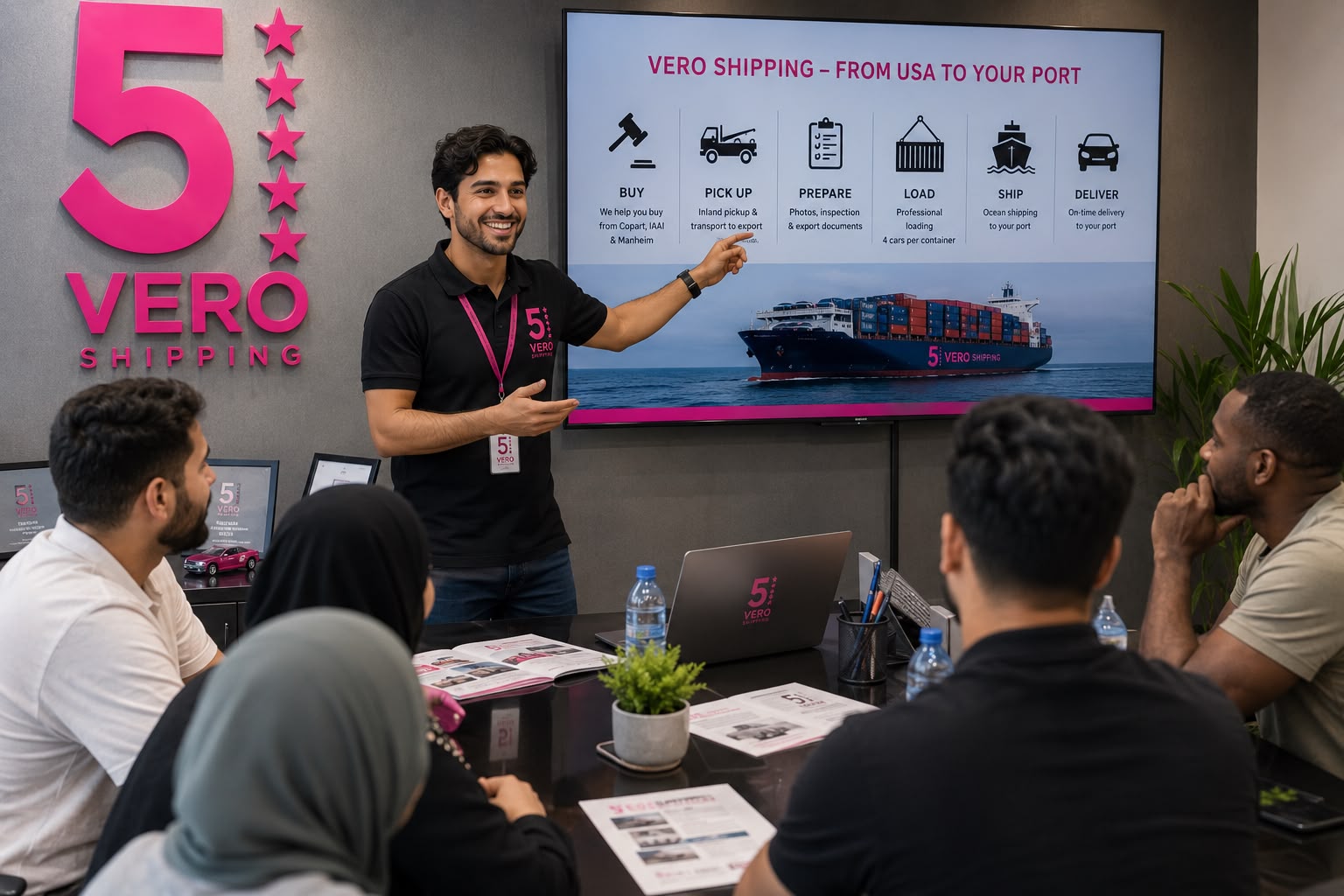
How Long Does Car Shipping from USA to Nigeria Take? Complete Timeline
18 Aug 2026
How Long Does Car Shipping from USA to Nigeria Take? Complete Timeline
Written by Abu Naif – International Shipping Expert | VERO Shipping
Meta Title: How Long Does Car Shipping from USA to Nigeria Take? | Complete Timeline
Meta Description: How long does it take to ship a car from USA to Nigeria? Learn the complete timeline from auction pickup and inland transport to title processing, container loading, ocean freight and arrival in Nigeria.
How Long Does Car Shipping from USA to Nigeria Take?
One of the most common questions Nigerian vehicle buyers ask after purchasing a car in the United States is: How long will it take for my vehicle to reach Nigeria?
The answer depends on much more than the ocean voyage.
The complete shipping timeline can begin when the vehicle is released by Copart, IAA, a dealership or another seller. The vehicle may then require inland transportation to the export facility, receiving and photography, title and export-document processing, container preparation, loading, U.S. export clearance and finally ocean transportation toward Nigeria.
A vehicle that is already close to an export facility and has complete documents may progress much faster than a vehicle located hundreds of miles away with a delayed title.
VERO Shipping coordinates these origin-side stages, including inland transportation, export documentation, container loading and ocean freight.
The most accurate way to estimate your shipping time is therefore to examine the entire vehicle journey, not just the vessel transit.
1. The Shipping Timeline Starts Before the Vessel Departs
Many first-time buyers think shipping time begins when the vessel leaves the United States.
In reality, your vehicle's logistics journey usually begins much earlier.
After purchasing a vehicle, it first needs to be available for release. Transportation must then be arranged from its current location to the appropriate export facility.
After arrival, the vehicle needs to be received and connected with the correct shipment record. Documentation must also be ready before it can progress toward export.
Only after the appropriate vehicles and documents are ready can container preparation and loading take place.
This distinction is important because two customers using the same ocean service may experience very different total timelines.
One vehicle could be ready quickly, while another might spend additional time waiting for auction release, inland transportation or documentation.
When asking how long car shipping from USA to Nigeria takes, always separate the pre-export timeline from the actual ocean-transit period.
Explore VERO USA Vehicle Export Services
2. Auction Release Can Affect the First Stage
If you purchased your vehicle from Copart, IAA or another U.S. auction, the first question is whether the vehicle is actually available for transportation.
Winning and paying for a vehicle does not necessarily mean that a transporter can immediately collect it.
Release information needs to be available and correct before dispatch.
If a transporter is sent before the vehicle is properly released, the pickup may fail and the shipment timeline can become longer.
For this reason, Nigerian buyers should provide the VIN, lot number, auction location and release information as soon as possible.
Dealers purchasing multiple vehicles should monitor each unit individually because vehicles purchased during the same week may become available at different times.
The faster the release information is confirmed and transportation is organized, the sooner the vehicle can begin moving toward the export facility.
This early stage can make a meaningful difference to the complete USA-to-Nigeria shipping timeline.
VERO USA Vehicle Shipping Services
3. USA Inland Transportation Time Depends on Location
After release, the vehicle needs to travel from its current location to the designated export facility.
This is one of the biggest variables in the pre-export timeline.
A vehicle located relatively close to an export facility may arrive much sooner than one located hundreds or thousands of miles away.
Transportation availability also matters. The logistics team needs to find an appropriate transporter for the route and the vehicle's condition.
Running vehicles are generally easier to handle than cars with severe collision damage, locked wheels or other problems requiring special equipment.
Weather, traffic, transporter availability and auction operating schedules can also influence pickup and delivery.
For Nigerian customers buying vehicles in several U.S. states, this means the cars may not reach the export facility together.
VERO coordinates inland transportation throughout the United States as part of its international vehicle-export operations.
VERO Shipping USA Inland Transportation
4. Receiving the Vehicle at the Export Facility
When the vehicle reaches the designated facility, another stage begins.
The vehicle needs to be received and matched with the correct VIN and shipment information. Available vehicle photographs and records can also provide customers with visibility after domestic transportation.
This stage becomes especially important for Nigerian dealers managing multiple vehicles.
For example, a dealer may have one vehicle arriving from Texas, another from Georgia and another from New Jersey. Each automobile can reach the facility on a different date.
The shipment cannot simply be treated as one group until the required vehicles are physically available and sufficiently ready for the next stage.
Good receiving records help the logistics team determine which cars have arrived and which are still moving within the United States.
VERO's broader vehicle-export operation includes vehicle transportation, preparation and container loading before international shipment.
Learn More About VERO Vehicle Shipping
5. Title Delays Can Change the Entire Timeline
One of the most important factors Nigerian buyers should understand is that physical arrival and export readiness are not the same thing.
Your vehicle might already be at the export facility while its documentation is not yet ready.
This can happen when title or ownership documentation is delayed or requires additional review.
For a dealer with several vehicles, one car may therefore be ready for export while another purchased around the same time is still waiting.
This is why customers should send available documentation as early as possible.
The VIN on the vehicle and the relevant ownership information need to correspond correctly with the export shipment.
If a documentation issue is discovered late, it can interfere with container planning and potentially move the vehicle into a later shipment.
A fast inland pickup cannot compensate for a vehicle that is not legally ready for export.
So when estimating the complete USA-to-Nigeria timeline, always include document readiness.
VERO Shipping Export Documentation Services
6. U.S. Export Requirements Add a Mandatory Timing Stage
Used vehicle export from the United States involves federal export requirements that cannot simply be skipped to make a shipment faster.
U.S. Customs and Border Protection states that export documents for used self-propelled vehicles must be submitted to the port of export at least 72 hours before export. CBP also states that Electronic Export Information must be filed in AES 72 hours before export for used self-propelled vehicles being exported to foreign countries.
This is important when calculating a realistic vehicle-export timeline.
Even if the vehicle is physically ready and a vessel is approaching, the required export procedures still have to be completed correctly.
Professional planning therefore means working backward from the intended export schedule and ensuring that the vehicle's documents are available early enough.
Customers should never interpret the 72-hour requirement as the entire documentation process. Other preparation can occur before that point.
U.S. CBP Vehicle Export Requirements
7. Waiting for the Right Container Group Can Affect Timing
For customers shipping multiple vehicles, container planning introduces another timing factor.
The vehicles selected for a shipment need to be physically available, appropriately documented and suitable for the planned loading configuration.
Imagine a Nigerian dealer has four vehicles intended for an upcoming shipment. Three have arrived and are ready, but the fourth is still traveling from another state or waiting for documentation.
The dealer and logistics team then need to determine the best available shipping plan.
Vehicle dimensions also matter. Sedans, SUVs, pickups and damaged cars do not necessarily create the same loading configuration.
This is why the number of vehicles alone does not determine when a container can be prepared.
The actual vehicles must be evaluated.
VERO provides professional container loading as part of its international vehicle-shipping services, alongside inland transportation and export preparation.
VERO Container Vehicle Shipping
8. Container Loading Is Not the Same as Vessel Departure
Another common misunderstanding is assuming that once the cars are loaded, the vessel leaves immediately.
Loading is an important milestone, but several logistics steps can still exist between container preparation and actual vessel departure.
The container needs to follow the planned export and carrier process, and the shipment must meet applicable cutoffs.
The vessel schedule also matters.
If a planned sailing changes or the container misses a required operational cutoff, the shipment may move according to the next available carrier arrangement.
This is why customers should distinguish between:
Vehicle loaded → Container prepared → Export process → Carrier movement → Vessel departure
These are related stages, but they are not necessarily the same date.
For Nigerian customers tracking a shipment, the actual vessel departure is therefore a more meaningful milestone for calculating ocean transit than the date the vehicle was originally loaded.
9. Ocean Transit Time Depends on the U.S. Origin and Carrier Routing
After the vessel departs, the international ocean-transit stage begins.
There is no single transit time that applies to every USA-to-Nigeria shipment.
The timeline depends on the U.S. export gateway, carrier, routing, vessel schedule, possible transshipment arrangements and the Nigerian destination port.
A shipment leaving from one U.S. region may follow a different ocean route from a container originating from another gateway.
For this reason, customers should request the current estimated transit associated with their actual booking rather than using a generic number found online.
Even two shipments departing during different weeks can follow different schedules.
The key distinction is that estimated ocean transit is only one part of the complete shipping timeline.
A customer asking how long it takes to receive a vehicle in Nigeria should add the pre-export stages to the estimated maritime journey.
Contact VERO for Current Nigeria Shipping Schedules
10. Vessel Schedules Can Change After Booking
International shipping schedules are estimates rather than absolute guarantees.
A vessel schedule can change because of operational adjustments, port congestion, weather, routing changes, equipment availability or other maritime conditions.
This does not necessarily mean there is a problem with the customer's vehicle.
Sometimes the vehicle and container are fully prepared, but the carrier's schedule changes.
For this reason, Nigerian dealers should avoid promising customers an exact arrival day too early in the shipment.
It is better to work with estimated departure and arrival information and update those estimates as the shipment progresses.
The closer the container gets to its destination, the more useful current carrier information becomes.
This also explains why an old shipment should not automatically be used to predict a new one.
The most relevant timeline is always the one associated with the customer's current booking and container.
VERO Vehicle and Container Tracking
11. What Happens When the Shipment Reaches Nigeria?
The vessel reaching Nigeria is an important milestone, but customers should distinguish ocean arrival from the point when the vehicle is physically available to them.
After arrival, the container enters destination-port procedures.
Port operations, container discharge, documentation, customs procedures and other destination requirements can affect how long it takes before the importer completes the local process.
These destination stages are separate from the U.S. export and ocean-transit timeline.
For this reason, when someone asks, "How many days until my car reaches Nigeria?" we need to understand whether they mean:
When does the vessel arrive?
or:
When can I actually receive the vehicle after local procedures?
Those are not necessarily the same date.
VERO's USA-side export timeline should therefore be distinguished from Nigerian customs and destination procedures, which customers should verify according to their specific shipment and current local requirements.
Learn More About VERO International Shipping
12. How to Reduce Avoidable Shipping Delays
Some shipping delays are outside the customer's control, but others can be reduced through better preparation.
Start by sending complete vehicle information immediately after purchase. This includes the VIN, auction location, lot information, vehicle condition and release details.
Do not wait until the planned loading date to investigate title or documentation issues.
If the vehicle is damaged, tell the logistics team whether it starts, drives, steers and rolls so the correct transporter can be assigned.
Dealers purchasing multiple vehicles should monitor each unit individually instead of assuming all vehicles will become ready together.
Finally, keep realistic expectations about international vessel schedules.
The fastest shipping process is not created by rushing one stage. It comes from coordinating release, inland transportation, receiving, documentation, loading and ocean freight in the correct sequence.
That is the approach VERO uses across its vehicle export and international logistics operations.
Frequently Asked Questions About USA to Nigeria Car Shipping Time
1. How long does it take to ship a car from USA to Nigeria?
There is no single number of days that applies to every vehicle because the complete shipping timeline contains several separate stages.
Before the ocean voyage begins, the vehicle may need to be released by an auction or seller, collected by a transporter, moved to the export facility, received, documented and prepared for loading.
The U.S. export process also has mandatory timing requirements. CBP states that the required used-vehicle export documents must be submitted to the port of export at least 72 hours before export.
After the container is exported, ocean transit depends on the U.S. departure gateway, carrier routing, vessel schedule and destination.
For this reason, VERO recommends calculating the timeline from the vehicle's current status, not simply asking for the number of days at sea.
A vehicle already at the facility with complete documentation may progress considerably differently from a newly purchased vehicle located far from the export gateway.
Ask VERO for a Current Shipping Timeline
2. When does the shipping timeline actually start?
For practical planning, the timeline should begin when the vehicle is ready to enter the logistics process.
If you purchased from an auction, that means the car needs to be paid and available for release before a transporter can successfully collect it.
After release, inland transportation begins.
Some customers count shipping time only from vessel departure, but that measures ocean transit, not the complete process from purchase to Nigeria.
For a Nigerian buyer, the more useful timeline is:
Vehicle release → Pickup → Inland transportation → Receiving → Documentation → Container preparation → U.S. export → Vessel departure → Ocean transit → Nigeria arrival.
Each stage can influence the final arrival date.
For example, a fast ocean service cannot compensate for several weeks lost before export because a vehicle was waiting for documentation.
Understanding where your vehicle currently sits within this sequence makes shipping-time estimates much more meaningful.
VERO Shipping USA Vehicle Export
3. Does the U.S. state where I buy the vehicle affect shipping time?
Yes. Vehicle location can significantly affect the pre-export portion of the timeline.
A car purchased relatively close to the intended export facility can usually complete inland transportation more quickly than a vehicle located much farther away.
However, distance is not the only factor.
Transporter availability, vehicle condition, auction hours, weather and pickup requirements can also affect timing.
A non-running vehicle requiring special loading equipment may take longer to coordinate than a normal running vehicle on the same route.
This becomes especially important for Nigerian dealers buying several vehicles from different U.S. states.
The vehicles may be purchased on the same day but arrive at the export facility at different times.
Dealers should therefore monitor the timeline of each VIN separately before deciding which vehicles will be grouped for the next international shipment.
VERO's services include inland vehicle transportation throughout the United States.
Contact VERO for USA Inland Transportation
4. Can a delayed title delay my shipment to Nigeria?
Yes. Title and documentation readiness can be one of the most important causes of pre-export delay.
A vehicle can physically reach the export facility before its documentation is ready.
That means seeing that your vehicle has arrived at the facility does not automatically mean it can be placed into the next export shipment.
The VIN and applicable ownership information need to be correctly connected with the export documentation.
Used vehicle exports from the United States are also subject to CBP procedures, including the 72-hour document-submission requirement.
For customers shipping several vehicles, documentation should therefore be monitored separately for every VIN.
If three cars are ready but a fourth has an unresolved title issue, that fourth vehicle can affect the intended loading plan.
Sending available documentation early gives the logistics team more time to identify issues before the targeted export date.
VERO Export Documentation Services
5. Does a damaged or non-running vehicle take longer?
It can.
A non-running vehicle does not automatically mean a major delay, but its actual condition affects the equipment required to transport and load it.
A vehicle that does not start but still rolls and steers can be easier to handle than one with damaged suspension, locked wheels or severe structural damage.
The biggest avoidable problem occurs when the transporter receives incorrect condition information.
If the driver arrives expecting a normal running vehicle and discovers that specialized loading assistance is necessary, the pickup can fail.
The transportation then needs to be rearranged, adding time to the process.
Nigerian buyers purchasing salvage vehicles should therefore provide accurate condition information immediately after purchase.
This allows VERO to coordinate an appropriate transportation method before dispatch.
Correct information at the beginning is one of the simplest ways to prevent avoidable inland transportation delays.
VERO Vehicle Shipping Services
6. Why is the 72-hour U.S. export rule important?
The 72-hour requirement is important because used vehicles cannot simply arrive at the export point and leave immediately without completing the applicable U.S. export procedures.
U.S. Customs and Border Protection states that all export documents for a used self-propelled vehicle must be submitted to the port from which the vehicle will be exported at least 72 hours prior to export. CBP also specifies the corresponding EEI/AES requirement for used self-propelled vehicles.
This requirement needs to be incorporated into shipment planning.
It does not mean that every vehicle will be ready exactly 72 hours after documentation begins. The vehicle's paperwork needs to be correct first.
Customers should therefore send documentation early instead of waiting until a vessel is about to depart.
Proper export planning protects the shipment from unnecessary last-minute problems and helps align the vehicle with the intended sailing.
Read Official CBP Vehicle Export Requirements
7. How long after loading does the container leave the USA?
There is no guaranteed fixed period between vehicle loading and vessel departure.
Loading the vehicles means the physical container-preparation stage has been completed, but the shipment still needs to follow the relevant export, terminal and carrier schedule.
The intended vessel has operational cutoffs, and departure dates can change.
For this reason, customers should not automatically treat the vehicle-loading date as the ocean-shipping start date.
The more useful milestone is confirmation that the shipment has progressed through export and the vessel has actually departed.
Once that happens, the customer can focus more directly on the estimated ocean-transit portion of the journey.
VERO customers can use available shipment information to follow vehicles and later container-level progress.
This distinction is especially useful for Nigerian dealers managing several containers because each shipment may have a different loading date, vessel departure and estimated arrival.
8. Can several cars purchased at the same time arrive in Nigeria on different dates?
Yes.
Purchasing several vehicles on the same day does not guarantee that they will all follow the same shipment.
One car may be released quickly, while another remains at the auction longer. A third vehicle might be located much farther from the export facility.
Documentation can also progress at different speeds.
If all vehicles become ready within the appropriate timeframe and work within the intended container plan, they may be shipped together.
If not, some vehicles may need to move with a later shipment.
This is why professional dealers should track every vehicle individually by VIN instead of assuming that the purchase date determines the shipping group.
VERO's digital system allows customers to search available information using VIN or lot details and also provides booking/container search functionality.
For Nigerian dealers handling regular purchases, this type of visibility becomes particularly valuable.
VERO VIN and Container Tracking
9. Can vessel delays increase the total shipping time?
Yes.
International vessel schedules can change even after a shipment has been planned.
Weather, congestion, operational adjustments, route changes and other carrier-related factors can influence departure or arrival estimates.
This is why international shipping companies normally work with estimated schedules rather than guaranteeing an exact arrival date far in advance.
Customers should distinguish these carrier-related changes from delays involving the vehicle itself.
If the vehicle was collected, documented, loaded and exported correctly but the vessel schedule changes, the additional time is related to the maritime portion of the shipment.
Nigerian dealers should therefore avoid making firm resale or collection commitments based on an estimated arrival date too early.
Instead, follow the latest available shipment and carrier information as the container progresses.
The current status of the actual shipment is more useful than comparing it with the timeline of a previous container.
10. How can I make my USA-to-Nigeria shipment move faster?
The best approach is to eliminate avoidable delays rather than trying to rush mandatory procedures.
Immediately after purchasing the vehicle, provide the correct VIN, auction or seller location, release information and vehicle condition.
Arrange inland transportation promptly once the vehicle is available.
Send title and ownership documentation as early as possible so export-readiness issues can be identified before container planning.
If the vehicle is damaged, clearly explain whether it starts, drives, rolls and steers. This helps prevent a transporter from arriving with unsuitable equipment.
For multiple vehicles, monitor every VIN separately and decide which cars are actually ready for the upcoming shipment.
Mandatory export requirements still need to be followed; for example, CBP's 72-hour vehicle-export requirement cannot simply be eliminated to make a shipment faster.
Good coordination across all stages is what creates an efficient overall timeline.
11. Can I track my car while waiting for shipment to Nigeria?
VERO provides an online tracking interface where customers can search using VIN or lot information, as well as booking or container information.
This is particularly useful because the shipment changes from a vehicle-level process into a container-level process as it progresses.
Before loading, the VIN is an important reference for following an individual car.
After loading and booking, container and booking information become increasingly important for understanding the international shipment.
For Nigerian dealers with multiple vehicles, this helps distinguish between cars that are still moving inland, cars that have reached the facility and vehicles already associated with later shipping stages.
Tracking also helps customers understand why two vehicles purchased at approximately the same time may currently have different statuses.
Digital visibility does not guarantee vessel schedules, but it provides a clearer picture of where the customer's shipment stands within the wider logistics process.
Track a Vehicle or Container with VERO
12. What information should I send VERO to estimate my shipping timeline?
Send the VIN, vehicle year, make and model, exact U.S. location, auction or seller information, running/non-running condition and available title information.
If the vehicle has already been purchased, also provide the available release information.
For multiple vehicles, send the details for each VIN separately.
This allows the logistics team to determine whether the vehicle still needs auction release, how far it needs to travel inside the United States and whether there are known documentation considerations before export.
If the vehicle is already at the VERO facility, the estimate can instead focus on export readiness, container planning and the available shipping schedule.
The key is to identify the vehicle's current stage.
Without that information, "How many days to Nigeria?" can only receive a broad answer. With the actual vehicle details, the timeline can be evaluated much more meaningfully.
Contact VERO Shipping for a Nigeria Shipping Timeline
Ready to Ship a Vehicle from USA to Nigeria?
The complete timeline does not begin at sea. It begins with the vehicle itself.
Auction/Seller → Release → USA Inland Transportation → VERO Facility → Vehicle Receiving → Documentation → Export Preparation → Container Loading → U.S. Export → Vessel Departure → Ocean Transit → Nigeria Arrival
VERO Shipping provides U.S. inland transportation, export preparation, professional container loading and international ocean-freight services as part of its vehicle-export operation.
To receive a more useful shipping-time estimate, send:
VIN • Make & Model • U.S. Location • Auction/Seller • Vehicle Condition • Title Status • Number of Vehicles


