

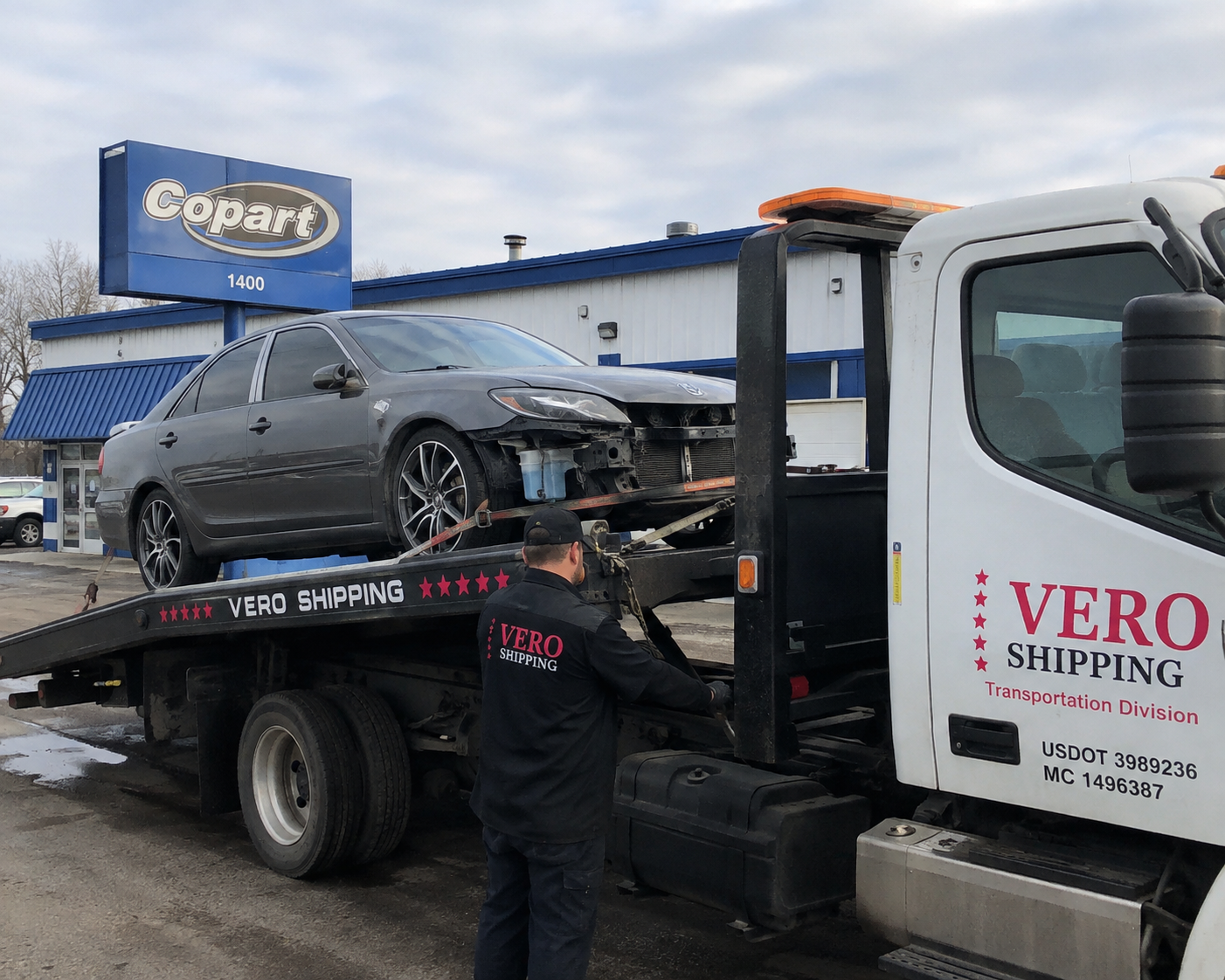
USA Vehicle Storage & Secure Handling | Copart, IAA & Manheim – VERO Shipping
12 Aug 2026
Buying a vehicle from Copart, IAA, Manheim, or another U.S. auto auction does not always mean the vehicle can immediately be loaded into a container and exported.
After auction pickup and inland transportation, many vehicles need to remain at a loading facility while the original title is received, export documents are prepared, other vehicles arrive for the same container, or an ocean booking is confirmed.
For international buyers, this stage is extremely important. The customer may be thousands of miles away from the vehicle and needs to know that the car has been collected, documented, stored, and prepared properly for export.
VERO Shipping coordinates vehicle pickup, inland transportation, secure handling, photography, documentation, container loading, and international shipping through its U.S. operations and contracted partners.
For more information about moving vehicles from U.S. auctions to loading facilities, read:
VERO USA Inland Vehicle Transportation Guide
https://veroshipping.com/NewsDetails.aspx?id=231
Why Do Auction Vehicles Need Storage?
There are several reasons why a vehicle purchased from a U.S. auction may need temporary storage before international shipping.
The original title may not have arrived yet. Another vehicle planned for the same container may still be at Copart or IAA. Export documents may be under preparation, or the shipping line booking may not yet be ready.
In some cases, moving the vehicle quickly from the auction can be important because additional auction storage charges may begin after the applicable free-storage period.
VERO's objective is therefore to coordinate pickup as soon as reasonably possible after release and move the vehicle toward the appropriate loading facility.
Once there, the next stages of the export process can be coordinated.
From Copart, IAA & Manheim to the Loading Facility
VERO coordinates vehicle pickup from Copart, IAA, Manheim, dealerships, and other approved vehicle locations throughout the United States.
Vehicles can then be transported to loading facilities or contracted partner facilities serving major U.S. export regions, including:
New Jersey
Savannah, Georgia
Houston, Texas
Los Angeles, California
The correct facility depends on where the vehicle was purchased, inland transportation cost, vehicle condition, ocean route, container availability, and final international destination.
This is why calculating inland transportation before purchasing a vehicle can be important.
A cheaper auction vehicle located far away from an export facility can sometimes become more expensive after inland transportation is added.
Customers buying from U.S. auctions can also review VERO's auction shipping information:
Copart & IAA Vehicle Shipping with VERO
https://veroshipping.com/NewsDetails.aspx?id=61
Secure Vehicle Handling in the USA
Vehicle storage for international export involves more than simply parking a car.
Vehicles purchased from auctions can arrive in many different conditions.
Some are clean vehicles. Others may be salvage, accident-damaged, non-running, missing parts, have flat tires, damaged suspension, or missing keys.
For this reason, VERO coordinates handling according to the vehicle's condition and the requirements of the shipment.
The objective is to minimize unnecessary movement while the vehicle is waiting for documentation, other vehicles, or container loading.
VERO works through its own operations and contracted U.S. partners depending on the location and shipment.
Vehicle Photography & Condition Documentation
Photography is particularly important when the customer is outside the United States.
A buyer in Dubai, Sharjah, Sohar, Muscat, Baghdad, Amman, Tbilisi, or another international destination may never physically see the vehicle before it leaves America.
Available photographs can therefore be used to document the vehicle during important stages of the shipping process.
The process may include:
Auction Pickup → Inland Transportation → Facility Arrival → Vehicle Photography → Secure Handling → Container Loading → International Shipping
This creates better visibility for the customer and provides useful vehicle-condition documentation.
What Happens When a Vehicle Arrives Damaged?
Many Copart and IAA vehicles already have damage when purchased.
This is why the vehicle's auction photographs and available condition records are important.
If additional damage is noticed after transportation, available photographs and handling information can be reviewed to better understand the vehicle's condition and determine appropriate follow-up.
Customers purchasing salvage vehicles should always remember that auction vehicles can have existing mechanical, structural, cosmetic, or electrical damage.
Missing Keys at Copart or IAA
Missing keys are another problem that can affect vehicle handling.
Sometimes a vehicle is advertised with a key or a key can be seen in auction photographs, but when the transporter arrives for pickup, the key cannot be located.
This creates a practical transportation problem.
A vehicle without a key may be difficult to steer, shift into neutral, start, or move during loading.
VERO follows up on these situations and coordinates available solutions so the vehicle can continue through the transportation process whenever possible.
Title Problems While the Vehicle Is in Storage
A vehicle and its original title do not always arrive together.
The transporter may successfully collect the vehicle and deliver it to the loading facility while the original title is still being processed or mailed.
In this situation, the vehicle may need to wait before international export.
VERO can assist customers with reviewing title and export-document issues and pursuing appropriate legal solutions where available.
However, transporting a vehicle to a loading facility does not automatically make the vehicle eligible for export.
Applicable U.S. ownership and export-document requirements must still be satisfied.
Waiting for Other Vehicles in the Same Container
International vehicle exporters frequently load multiple vehicles inside one container.
Those vehicles may come from different states and different auctions.
For example, one vehicle might be purchased from Copart in New Jersey while another vehicle is being transported from Pennsylvania or another nearby state.
One car may arrive quickly while another may be delayed because of an auction appointment, title problem, weather, transportation availability, or vehicle condition.
The vehicles that arrive first may therefore need to remain at the facility until the container shipment is complete.
Good coordination between inland transportation and storage helps reduce unnecessary waiting time.
Snow, Flooding & Severe Weather
Weather can also affect vehicle storage and transportation.
Heavy snow and ice can affect auction operations and highways during winter.
Flooding, hurricanes, severe rain, and storms can affect transportation in other regions of the United States.
When weather conditions interfere with pickup, the priority is to move the vehicle when conditions and transporter availability allow it to be done safely.
This is especially important when multiple vehicles are being assembled for one international container.
Preparing Vehicles for Container Loading
Once the vehicles and required documentation are ready, the shipment can move to the next stage: container loading.
The vehicles are prepared according to the planned container configuration and their individual condition.
Non-running and damaged vehicles may require different loading procedures from normal running vehicles.
Vehicle condition can also be documented before or during loading.
Customers who want to learn more about VERO's container shipping process can read:
VERO Container Shipping Guide
https://veroshipping.com/NewsDetails.aspx?id=38
Online Vehicle & Container Tracking
International customers should also be able to follow the progress of their vehicles after they leave the auction.
VERO provides online vehicle and container tracking using available shipment information.
Depending on the stage of transportation, customers may use information such as a VIN, LOT number, booking number, or container number.
Track Your Vehicle or Container with VERO
https://veroshipping.com/buyerlogin.aspx
This is particularly useful for international customers because they can follow shipment information without being physically present in the United States.
Follow Your Shipment Through the VERO Shipping App
VERO customers can also use the VERO Shipping mobile application.
The application provides another way for customers to access available vehicle and shipment information online while their vehicles move through the logistics process.
For customers managing several auction vehicles, having shipment information available through a mobile device can make communication and tracking easier.
VERO Shipping App for iPhone & iPad
https://apps.apple.com/ae/app/vero-shipping/id1668791428
From USA Storage to UAE, Oman, Iraq & Jordan
Vehicle storage and handling in the United States is only one part of the international shipping process.
After documentation and container preparation are completed, VERO can coordinate ocean transportation to multiple international markets.
For customers shipping vehicles to the United Arab Emirates:
Car Shipping from USA to UAE – VERO Shipping
https://veroshipping.com/car-shipping-from-usa-to-uae.aspx
For customers shipping vehicles to Oman:
Car Shipping from USA to Oman – VERO Shipping
https://veroshipping.com/ship-car-to-oman.aspx
VERO also coordinates vehicle shipping routes serving Iraq, Jordan, Georgia, Turkey, Africa, and other international markets depending on current shipping availability and destination requirements.
Why Secure Handling Matters for International Buyers
For an international buyer, the U.S. side of the shipment is extremely important.
Purchasing the vehicle is only the beginning.
The vehicle still needs to be released, collected from the auction, transported, documented, stored when necessary, prepared for export, loaded, and shipped internationally.
A problem at any one of these stages can delay the entire shipment.
VERO's role is to coordinate these stages and provide customers with a more connected process from the U.S. auction to international shipping.
The objective is simple: move the vehicle efficiently, document its condition, reduce unnecessary delays, and prepare it correctly for export.
29 Questions About USA Vehicle Storage & Secure Handling
1. Why would my auction vehicle need storage?
A vehicle may need temporary storage while waiting for its title, export documentation, other vehicles for the same container, or an ocean booking.
2. Can VERO arrange handling after Copart pickup?
Yes. VERO can coordinate the next stages after the vehicle has been collected from Copart.
3. Can VERO handle vehicles purchased from IAA?
Yes. IAA vehicles can be transported to the appropriate facility for export preparation.
4. What about Manheim vehicles?
VERO can coordinate eligible vehicles purchased from Manheim, subject to release and transportation requirements.
5. Where are vehicles handled in the USA?
VERO's operations and contracted partners serve major export regions including New Jersey, Savannah, Houston, and Los Angeles.
6. Does VERO photograph vehicles after arrival?
Available photographs can be taken during important stages of vehicle handling.
7. Why are vehicle photographs important?
They provide international customers with additional visibility into the condition of vehicles located in the United States.
8. Can VERO handle salvage vehicles?
Yes. Salvage vehicles are common in international auction shipping.
9. Can VERO handle non-running vehicles?
Yes, although special transportation or loading equipment may sometimes be necessary.
10. Can luxury vehicles be handled?
Yes. Vehicle condition, dimensions, and value can be considered when planning handling and loading.
11. What happens if the vehicle has no key?
A missing key may complicate vehicle movement. VERO can follow up on available solutions depending on the circumstances.
12. What if Copart showed a key but the key is missing at pickup?
The situation can be documented and followed up with the auction where appropriate.
13. Can my vehicle wait at the facility while the title is pending?
Yes. A pending title is one reason a vehicle may need temporary storage.
14. Can VERO export the vehicle without the required documents?
No. Applicable U.S. export requirements must be satisfied before the vehicle can legally be exported.
15. Why would my vehicle wait for another vehicle?
Several vehicles may be planned for the same container and may arrive from different auctions at different times.
16. Can an auction appointment delay my container?
Yes. If one vehicle cannot be collected on time, container preparation may also be delayed.
17. Can snow delay transportation to the facility?
Yes. Heavy snow and ice can affect auction operations, roads, and transporter availability.
18. Can flooding cause delays?
Yes. Flooding and severe storms can affect pickup and inland transportation.
19. Does VERO handle classic vehicles?
VERO can coordinate classic vehicles subject to their condition, documentation, and transportation requirements.
20. Can sports cars be handled?
Yes. Sports cars can be transported and prepared for export according to their individual requirements.
21. What happens if damage is noticed after transportation?
Available vehicle-condition information and photographs can be reviewed to determine appropriate follow-up.
22. Does VERO try to minimize unnecessary vehicle movement?
Yes. Efficient handling helps reduce unnecessary movement while preparing vehicles for export.
23. Can I track my vehicle online?
Yes. VERO provides online tracking using available vehicle and shipment information.
24. Does VERO have a mobile application?
Yes. The VERO Shipping App provides customers with another way to access available shipment information.
25. What happens after storage?
Once the required vehicles and documentation are ready, the shipment can proceed toward container loading.
26. Does VERO coordinate container loading?
Yes. VERO can coordinate container preparation and vehicle loading as part of the international shipping process.
27. Can VERO arrange ocean shipping after loading?
Yes. Depending on the route and destination, VERO can coordinate international ocean transportation.
28. Should I consider storage and inland transportation before bidding?
Yes. Buyers should consider the total logistics cost, not only the auction purchase price.
29. Can VERO coordinate the process from the auction to the international destination?
Yes. Depending on the route and shipment requirements, VERO can coordinate auction pickup, inland transportation, secure handling, documentation, container loading, and international ocean shipping.
VERO USA Vehicle Handling Process
Copart / IAA / Manheim → Vehicle Release → Auction Pickup → USA Inland Transportation → Secure Vehicle Handling & Storage → Vehicle Photography → Title & Export Documentation → Container Loading → Ocean Freight → International Destination


