

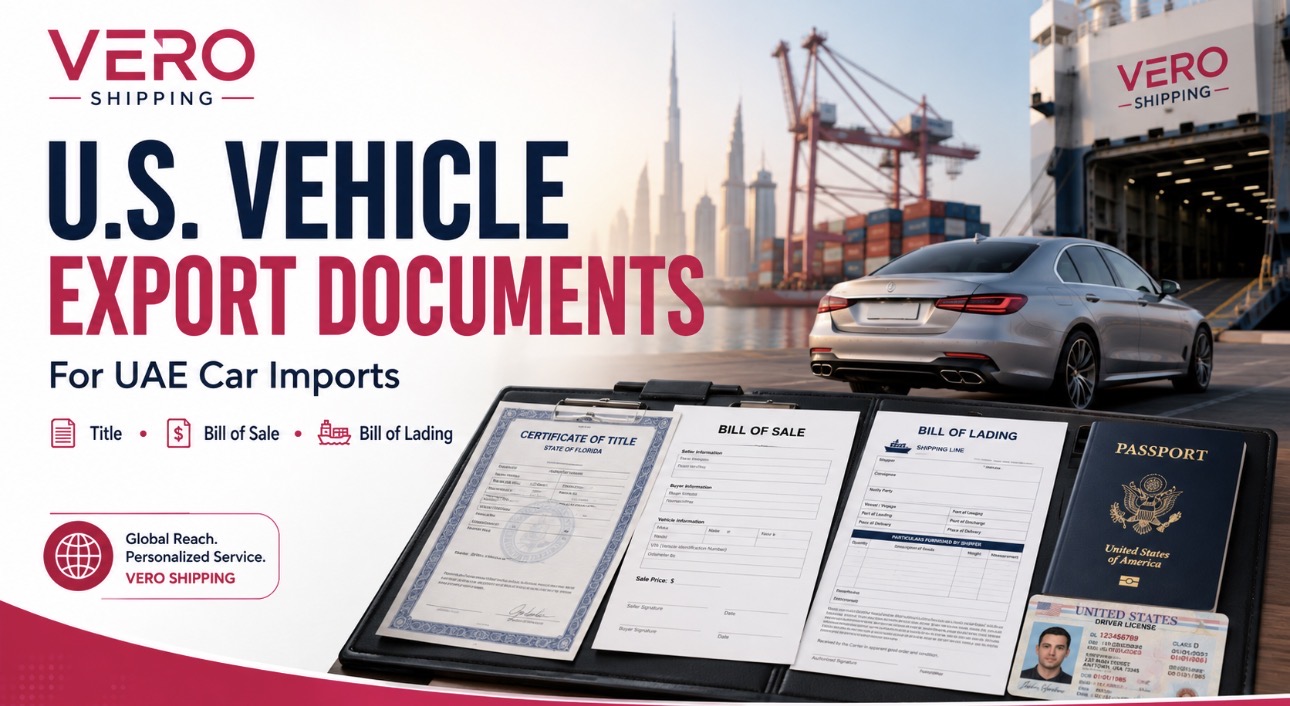
What Documents Do UAE Buyers Need Before Shipping a Car from the USA?
26 Jul 2026
U.S. Vehicle Export Documents Required for UAE Car Imports in 2026
By Abu Naif – Maritime Shipping Expert at VERO Shipping
Importing a vehicle from the United States to the UAE involves more than purchasing the car and booking ocean freight. The documentation is one of the most important parts of the entire process. A vehicle may be paid for, collected from Copart or IAA, and delivered to a loading facility, but it cannot proceed smoothly through export and customs procedures if the paperwork is incomplete or incorrect.
For UAE buyers, understanding the required documents before shipping can help prevent delays, additional storage costs, export holds and customs problems. This is especially important for customers importing vehicles into Dubai, Sharjah, Abu Dhabi, Ras Al Khaimah and other Emirates.
Customers looking for a broader overview of the transportation process can also visit our car shipping from the USA to the UAE page.
Why Vehicle Export Documents Matter
International vehicle shipping requires coordination between the buyer, auction or seller, inland transporter, shipping company, U.S. export authorities, ocean carrier and destination customs authorities.
Documents connect all of these stages. They establish who owns the vehicle, confirm the identity of the car, support export clearance and provide the information required for ocean transportation and UAE customs procedures.
A single mistake in a VIN, customer name or ownership document can sometimes delay the shipment even when the vehicle itself is physically ready.
1. Original Vehicle Title
The original vehicle title is usually one of the most important documents in the export process. It identifies the legal ownership of the vehicle and includes important details such as the VIN, make, model and ownership information.
For vehicles purchased through Copart or IAA, the title may be released after payment and completion of the auction's documentation process. Buyers should always check the title status before planning export.
A missing, delayed or incorrect title can create an export hold. For more information about this specific problem, read our guide about Copart missing titles and export holds for UAE buyers.
2. Bill of Sale or Purchase Invoice
The Bill of Sale or purchase invoice provides evidence of the transaction between the seller and buyer. It may show the purchase price, vehicle details, buyer information and seller information.
For auction vehicles, purchase documents can also help confirm where the vehicle was purchased and how much was paid.
This information may later be relevant during customs processing, valuation or document review at the destination.
3. Vehicle Identification Number (VIN)
The VIN must match across the important documents connected with the vehicle. Even a small typographical error can create confusion between the title, shipping instructions and customs documentation.
Before export, the VIN should be checked carefully on the vehicle and compared with the title and purchase documents.
Professional importers often make VIN verification part of their routine process because it is easier to correct a problem before loading than after the container has already been prepared for export.
4. Buyer or Consignee Identification
The shipping company may require identification and consignee information depending on the shipment structure.
For UAE customers, the consignee details should be entered accurately because those details can later appear on shipping documents such as the Bill of Lading.
Incorrect spelling of names, company information or contact details can create unnecessary delays when the shipment reaches the destination.
5. Shipping Instructions
Shipping instructions tell the freight forwarder and ocean carrier how the shipment should be documented.
These instructions can include the shipper, consignee, notify party, destination port, vehicle information and other shipment details.
The customer should review the information carefully before the final shipping documents are issued.
6. Bill of Lading
The Bill of Lading is one of the key documents used in international ocean transportation. It identifies the shipment, shipper, consignee, carrier and destination.
Once the container has been loaded and the shipment is processed by the carrier, Bill of Lading information becomes an important part of the journey.
At the destination, the Bill of Lading can also be required as part of the cargo release and customs process.
7. Auction Documents for Copart and IAA Vehicles
Vehicles purchased from American auctions often include additional documents related to the sale.
These documents should be reviewed and organized with the title and purchase records before export. Customers buying through Copart or IAA should not assume that every vehicle has exactly the same documentation status.
Some vehicles may have clean titles, others may have salvage titles, and some may still be waiting for document release.
8. Export Documentation in the United States
Before a vehicle leaves the United States, the shipment must comply with applicable export procedures.
This is separate from UAE customs clearance. The United States has its own export requirements, while the UAE has its own destination requirements.
A shipment can therefore face a problem before departure even if the buyer is already prepared for UAE customs.
9. Customs Documents Required After Arrival in the UAE
Once the vehicle arrives in the UAE, destination customs procedures begin.
Depending on the shipment and vehicle, UAE customs may require documents such as the Bill of Lading, vehicle title, purchase invoice or Bill of Sale, consignee identification and other supporting paperwork.
Customers importing through the Emirates can learn more through our VERO Shipping UAE vehicle import and shipping page.
10. Documents for Salvage Vehicles
Salvage vehicles are commonly purchased from U.S. auctions by international buyers. The important point is that the document type must be understood before shipping.
A salvage title is not the same as a missing title. The vehicle may have valid ownership documentation but still carry a salvage classification because of its history.
Buyers should understand the title type, export eligibility and destination requirements before arranging transportation.
11. Documents for Electric and Hybrid Vehicles
Electric and hybrid vehicles may require additional carrier review because lithium batteries can affect transportation procedures.
Depending on the shipping line and vehicle condition, additional information or dangerous-goods documentation may be required.
This is separate from the standard ownership documents and should be confirmed before booking the shipment.
12. Why Names and Addresses Must Match
A common documentation problem is inconsistency between different records. The buyer's name may appear one way on the purchase document and another way on the shipping instructions.
Company names, addresses and consignee details should be consistent whenever possible.
This makes the documentation easier to review and can reduce questions later during export or customs processing.
13. Why Dealers Need Better Document Organization
A customer importing one vehicle may only have a small number of documents to manage. A professional dealer importing ten, twenty or more vehicles can have a much more complicated situation.
Every vehicle may have a different VIN, title status, auction source and shipment stage.
For this reason, dealers should organize documents by vehicle rather than relying only on email conversations or WhatsApp messages.
14. Check Documents Before Container Loading
One of the best times to identify a documentation problem is before the vehicle is scheduled for container loading.
If a title is missing or information is incorrect, the shipment plan can be adjusted before the container is finalized.
Discovering the issue after loading can be much more complicated and may affect several vehicles in the same shipment.
15. How VERO Shipping Helps UAE Buyers
VERO Shipping assists customers through different stages of the vehicle logistics process, including auction purchasing support, vehicle pickup, inland transportation, document coordination, container loading and ocean shipping.
For customers shipping into Dubai, Sharjah, Abu Dhabi or other Emirates, VERO can help organize the transportation process from the United States through arrival at the destination.
The purpose of good documentation management is simple: identify problems early, reduce avoidable delays and make the shipping process easier to manage.
Final Document Checklist for UAE Vehicle Importers
- Original vehicle title
- Bill of Sale or purchase invoice
- Correct VIN information
- Buyer or consignee identification
- Shipping instructions
- Bill of Lading
- Auction paperwork when applicable
- U.S. export documentation
- UAE customs supporting documents
- Additional carrier documents for special vehicle types when required
Before shipping a vehicle internationally, customers should review the documents as carefully as they review the condition and price of the car.
A well-organized document file can save time, reduce confusion and help the vehicle move through the export and destination process more efficiently.
To learn more about VERO Shipping and international vehicle logistics, visit the official VERO Shipping website.


